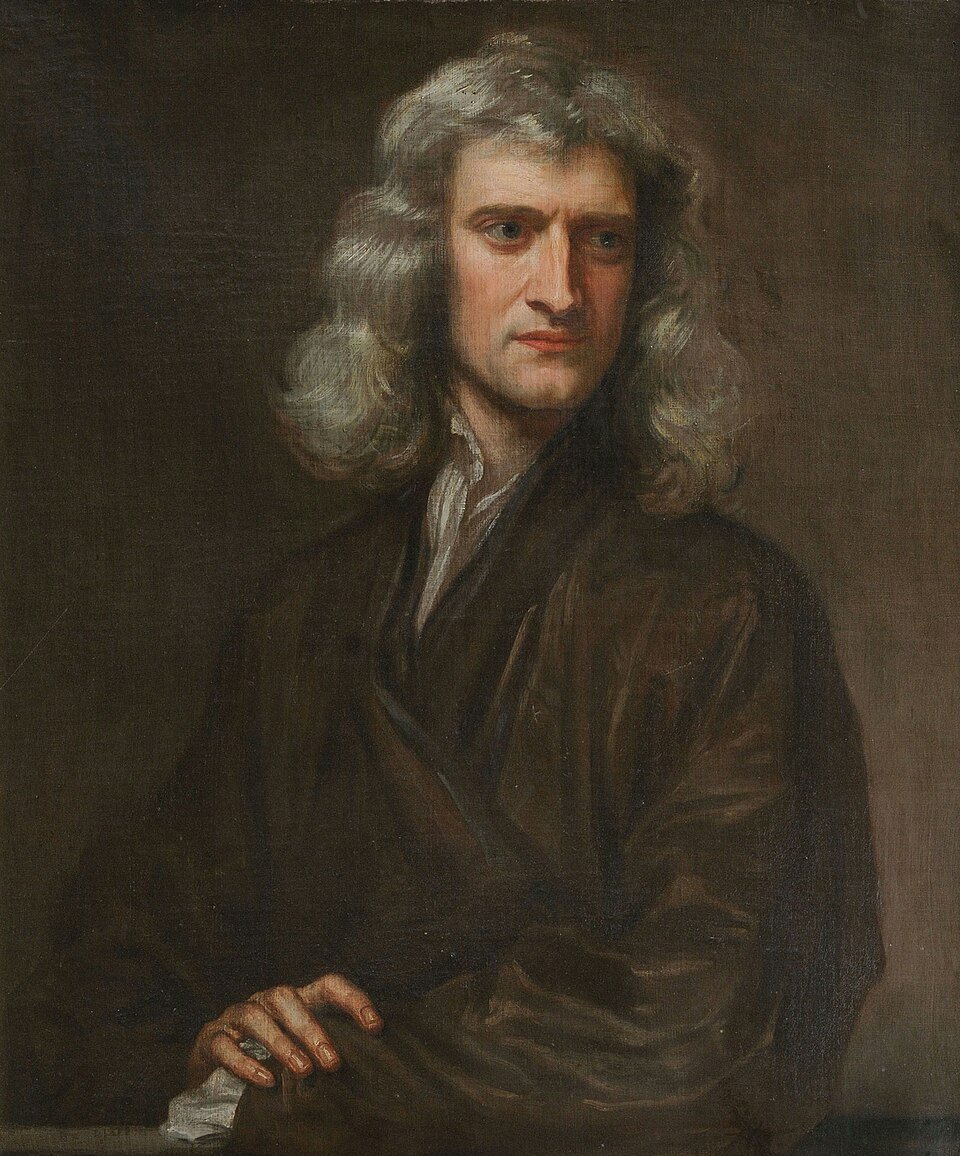
Who they were
In his Principia (1687) Newton set out three laws of motion and the law of universal gravitation, showing that the same force governs falling bodies and planetary orbits. He built the first reflecting telescope, analysed white light into the spectrum, and — independently of Leibniz — invented calculus, later presiding over the Royal Society and serving as Master of the Mint.
What they did
He unified terrestrial and celestial physics into a single mathematical system, the framework of physical science for over two centuries.
Legacy
Newton’s mechanics remained the foundation of physics until Einstein and quantum theory refined its limits, and his synthesis is a defining achievement of the Scientific Revolution.