Overview
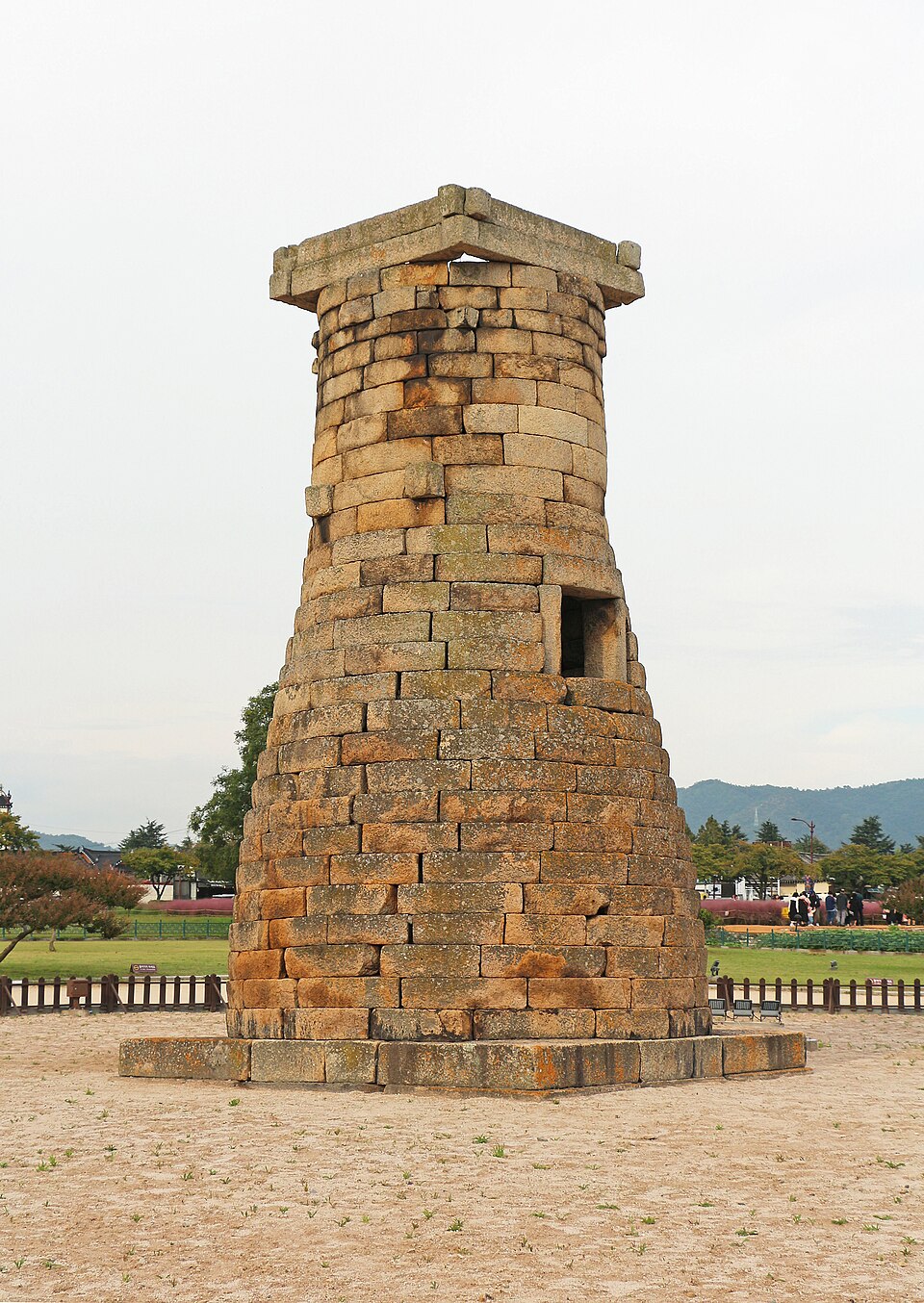
It was raised in the reign of Silla’s first ruling queen, in a capital whose royal tombs stand in the same fields around it, and it has never fallen down or been moved: what stands in Gyeongju is the seventh-century tower itself, not a reconstruction, which is rare for a structure of that age anywhere in East Asia. That survival is why the debate about it matters. Nothing was found inside, the platform on top is small for an instrument, and readings of the tower as an altar or as a monument to the queen’s reign compete with the observatory reading on equal evidence.
Description
It is a bottle-shaped tower about 9.4 metres tall, built of roughly 360 cut granite blocks laid up around a square window. Interpreters have long read calendar symbolism into its construction — the courses of stones counted as the days of the year, for example — though these readings remain interpretation rather than established fact.
History and legacy
Exactly how the tower was used is still debated among scholars. It is designated a National Treasure of Korea and has become an emblem of Gyeongju’s Silla heritage.