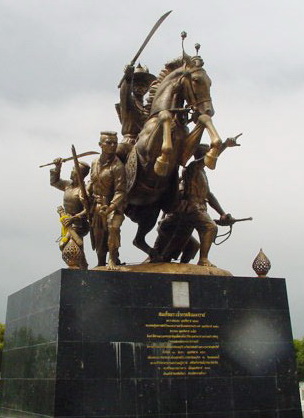
Who they were
Born in 1734 to a Teochew Chinese immigrant father and a Siamese mother, Taksin rose through provincial service to become governor of Tak — the origin of his name. As king of Thonburi (r. 1767–1782), he restored Siam after its greatest catastrophe.
What they did
By the chronicle account, he escaped besieged Ayutthaya with a small force, built a base at Chanthaburi, and retook the capital area within months of the 1767 fall. He founded his capital at Thonburi and in about three years defeated the rival regional regimes and reunified Siam. He repelled renewed Burmese attacks, took Chiang Mai with northern allies in 1775 — ending Burmese rule in Lan Na — and sent armies into Cambodia and Laos: Vientiane fell in 1779, as commonly dated, and the Emerald Buddha was brought to Thonburi. He revived trade through Chinese merchant networks.
Legacy
He was deposed in the 1782 crisis — the chronicles portray his last years as marked by erratic religious claims and harsh punishments, an account some historians read cautiously — and executed in April 1782; his general took the throne as Rama I. Revered as the savior-king, he is commemorated on December 28 and by an equestrian monument in Thonburi, and he remains a heroic figure for Thai-Chinese identity.