Overview
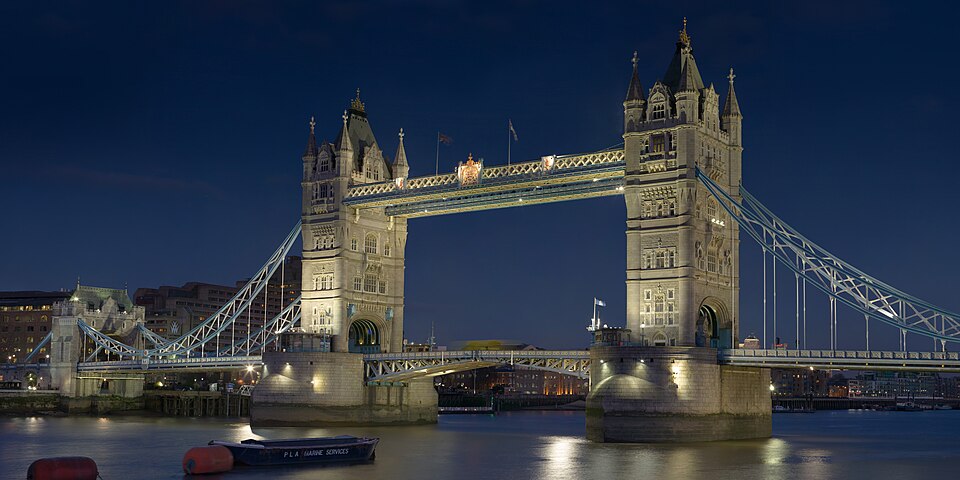
By the 1870s London’s growth east of London Bridge demanded a new crossing, but one that tall ships bound for the busy Pool of London could still pass. The solution, designed by the City architect Horace Jones with the engineer John Wolfe Barry, was a combined bascule and suspension bridge, built from 1886 and opened in 1894.
Description
Two towers on massive piers carry side spans hung on chains, while between them a pair of bascules, each weighing over a thousand tonnes, pivot upward to clear the channel; hydraulic power raised them from the start, steam-driven until electrification in 1976. Jones clad the steel skeleton in Cornish granite and Portland stone in a Gothic dress required to harmonize with the Tower of London, and high walkways linked the tower tops for pedestrians while the roadway stood open.
History and legacy
Mocked by some critics at its opening, the bridge became London’s emblem within a generation and remains a working crossing, its bascules still rising hundreds of times a year for river traffic. The walkways, closed in 1910 for lack of use, reopened in 1982 as part of the Tower Bridge Exhibition, and with its Victorian engine rooms the bridge now shows the machinery that made it the most sophisticated bascule bridge of its age.