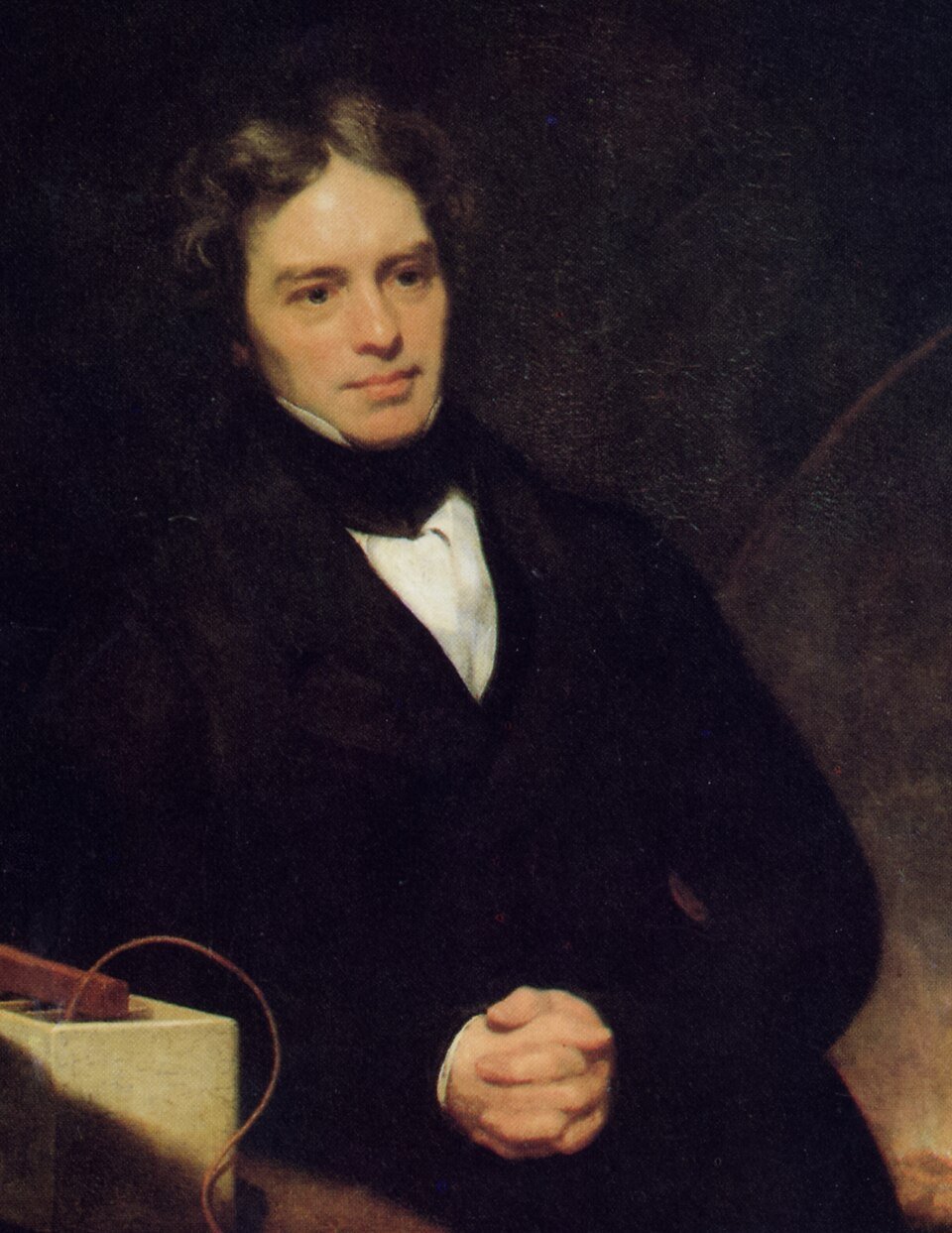
Who they were
Born to a poor London family, Faraday educated himself while apprenticed to a bookbinder, won a post as Humphry Davy’s assistant at the Royal Institution in 1813, and spent his whole career there, becoming its leading figure and a celebrated public lecturer who founded the Christmas Lectures for children.
What they did
He discovered electromagnetic rotation in 1821 and electromagnetic induction in 1831 — the principle behind the generator and the transformer — established the laws of electrolysis, discovered the magneto-optical effect and diamagnetism, and introduced the idea of fields of force, later given mathematical form by James Clerk Maxwell.
Legacy
Faraday’s induction underlies virtually all electricity supply today, and the farad, the unit of capacitance, bears his name. His rise from tradesman’s apprentice to scientific eminence, and his gift for public explanation, made him a lasting model of the experimental scientist.