Overview
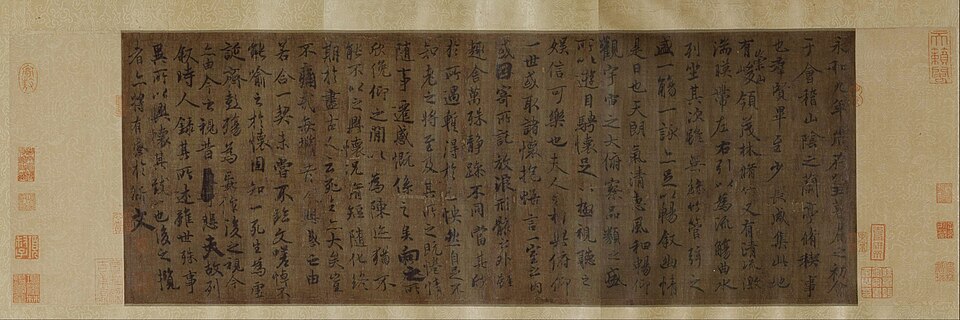
In AD 353 Wang Xizhi gathered a company of literati at the Orchid Pavilion near Shanyin, modern Shaoxing, for a gathering held for the spring purification festival, and drafted on the spot a preface to the poems composed that day. Wang Xizhi is revered as the Sage of Calligraphy, and this preface is regarded as the most celebrated work in the history of Chinese calligraphy.
Description
The text runs to 324 characters in 28 columns, a draft written in running script. Its brushwork has been praised by calligraphers through the ages for its endless variety, and it is traditionally said that no character appears twice in exactly the same form.
History and legacy
The original no longer survives. Emperor Taizong of Tang treasured the manuscript and, according to tradition, had it buried with him in his tomb. The work is transmitted through fine Tang-dynasty tracing copies, the most famous being the Shenlong copy attributed to Feng Chengsu, now held in the Palace Museum in Beijing.