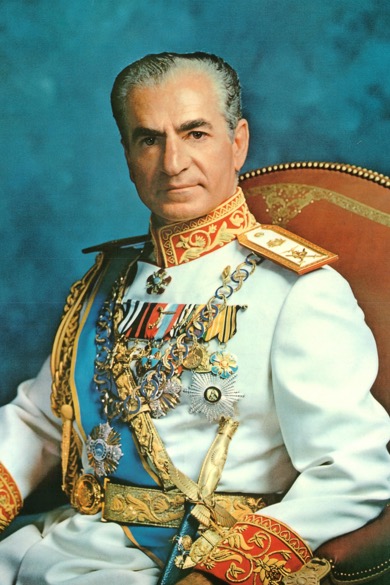
Who they were
Mohammad Reza Pahlavi (1919–1980) came to the throne in 1941 after his father’s forced abdication and reigned as the last shah of Iran until 1979. Through the 1940s he was a weak constitutional monarch; after the 1953 coup his royal power was restored and then steadily expanded. Standard historiography describes a personal style of rule that distrusted strong ministers and centralized decisions in the palace.
What they did
His White Revolution of 1963 brought land reform, literacy and health corps, and women’s suffrage — real social change, delivered autocratically. Riding the oil boom, he pursued a vision of Iran as a great power advancing toward a coming Great Civilization, backed by massive arms purchases as the United States’ regional pillar and a nuclear program begun with Western partners. At the same time he imposed a single-party state in 1975; SAVAK’s surveillance, imprisonment, and torture of opponents are documented, and resentments over censorship and court corruption accumulated.
Legacy
The revolution of 1978–79 ended his rule, and he left Iran on 16 January 1979. His admission to the United States for cancer treatment in October 1979 helped trigger the seizure of the US embassy in Tehran. He died in Egypt in July 1980 and is buried there. His legacy remains contested between the modernization he achieved and the autocracy that ended the monarchy — both readings have their advocates.