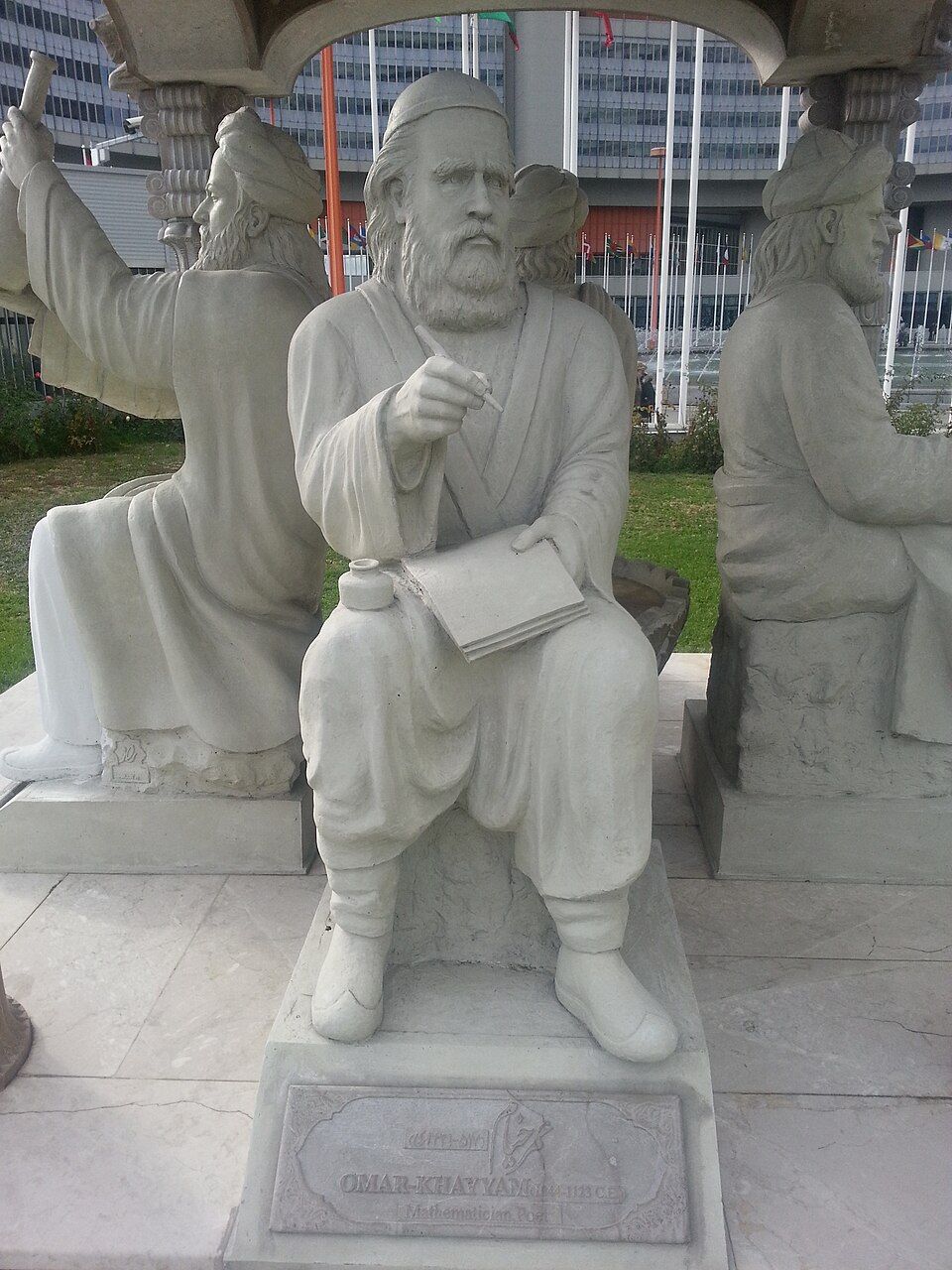
Who they were
Omar Khayyam was born in 1048 in Nishapur, in Khorasan, and died there in 1131. He was a mathematician, astronomer, and philosopher — and, by attribution, a poet.
What they did
His treatise on algebra gave systematic geometric solutions of cubic equations, among the landmarks of medieval mathematics; he also examined Euclid’s parallel postulate. In astronomy he led the observatory team for Malik-Shah whose Jalali calendar reform of 1079 produced a solar calendar of remarkable accuracy — the basis of Iran’s calendar today. The rubaiyat attributed to him, quatrains of skepticism, wine, and mortality, are of uncertain attribution, with scholars differing verse by verse and the corpus growing over the centuries.
Legacy
Edward FitzGerald’s Rubaiyat of Omar Khayyam (1859), a free adaptation rather than a literal translation, became among the most popular poems in the English language and a Victorian sensation. In Iran he is honored foremost as a scientist; worldwide he is the emblematic Persian poet-philosopher. His tomb at Nishapur is a modern monument.