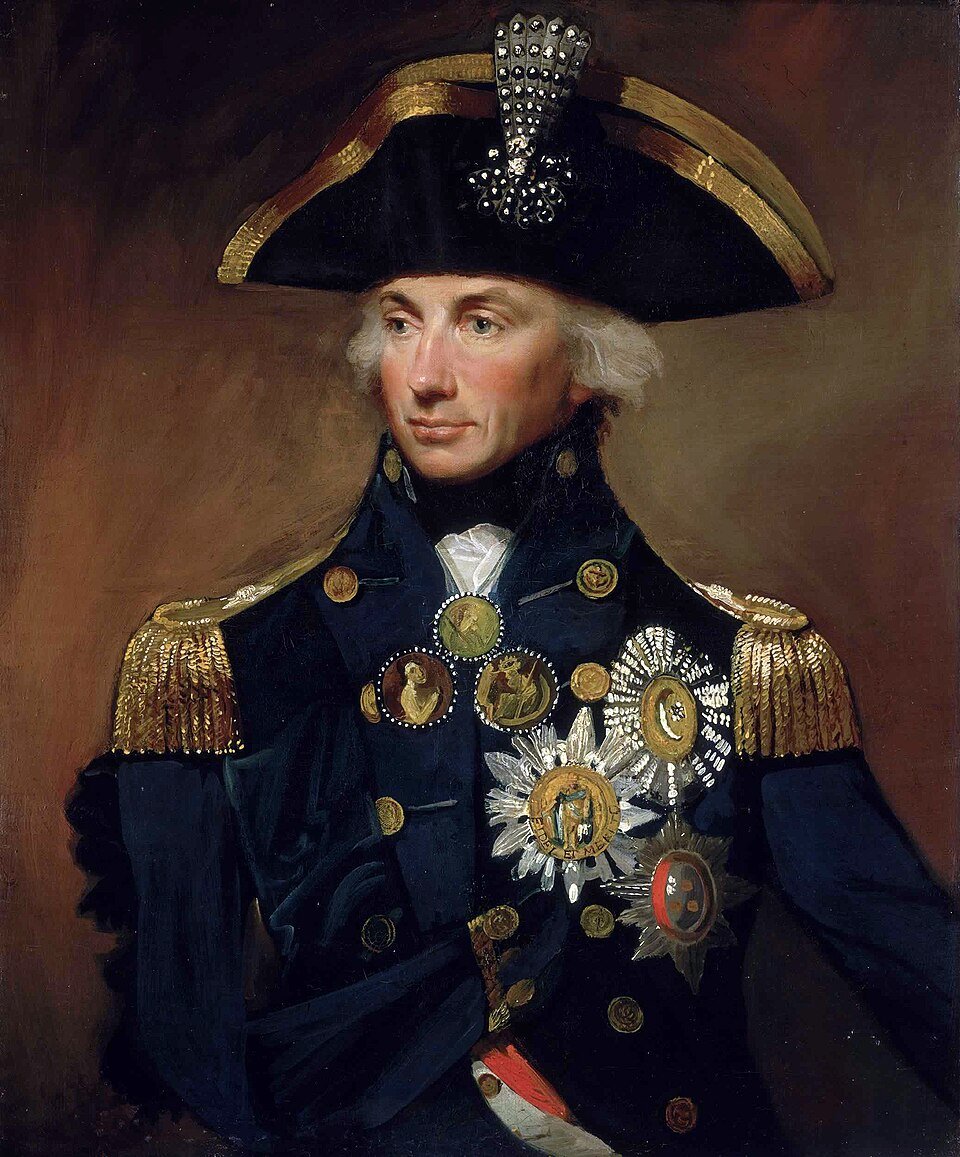
Who they were
A Norfolk clergyman’s son who went to sea at twelve, Nelson rose through the Royal Navy in the wars against revolutionary France, losing the sight of his right eye in Corsica and his right arm at Tenerife, and becoming famous for aggressive, close-quarters tactics and for the devotion he inspired in his crews.
What they did
He annihilated the French fleet at the Battle of the Nile in 1798, stranding Napoleon’s army in Egypt, and defeated the Danish fleet at Copenhagen in 1801. On 21 October 1805, off Cape Trafalgar, his fleet of twenty-seven ships attacked the Franco-Spanish line in two columns after his signal that England expects that every man will do his duty; twenty-two enemy ships were taken or destroyed and none of his own were lost, but Nelson was shot by a marksman aboard HMS Victory and died as the battle was won.
Legacy
Trafalgar ended the threat of invasion and underpinned British naval supremacy for the rest of the age of sail. Nelson was given a state funeral at St Paul’s Cathedral, and Trafalgar Square with Nelson’s Column remains his national monument.