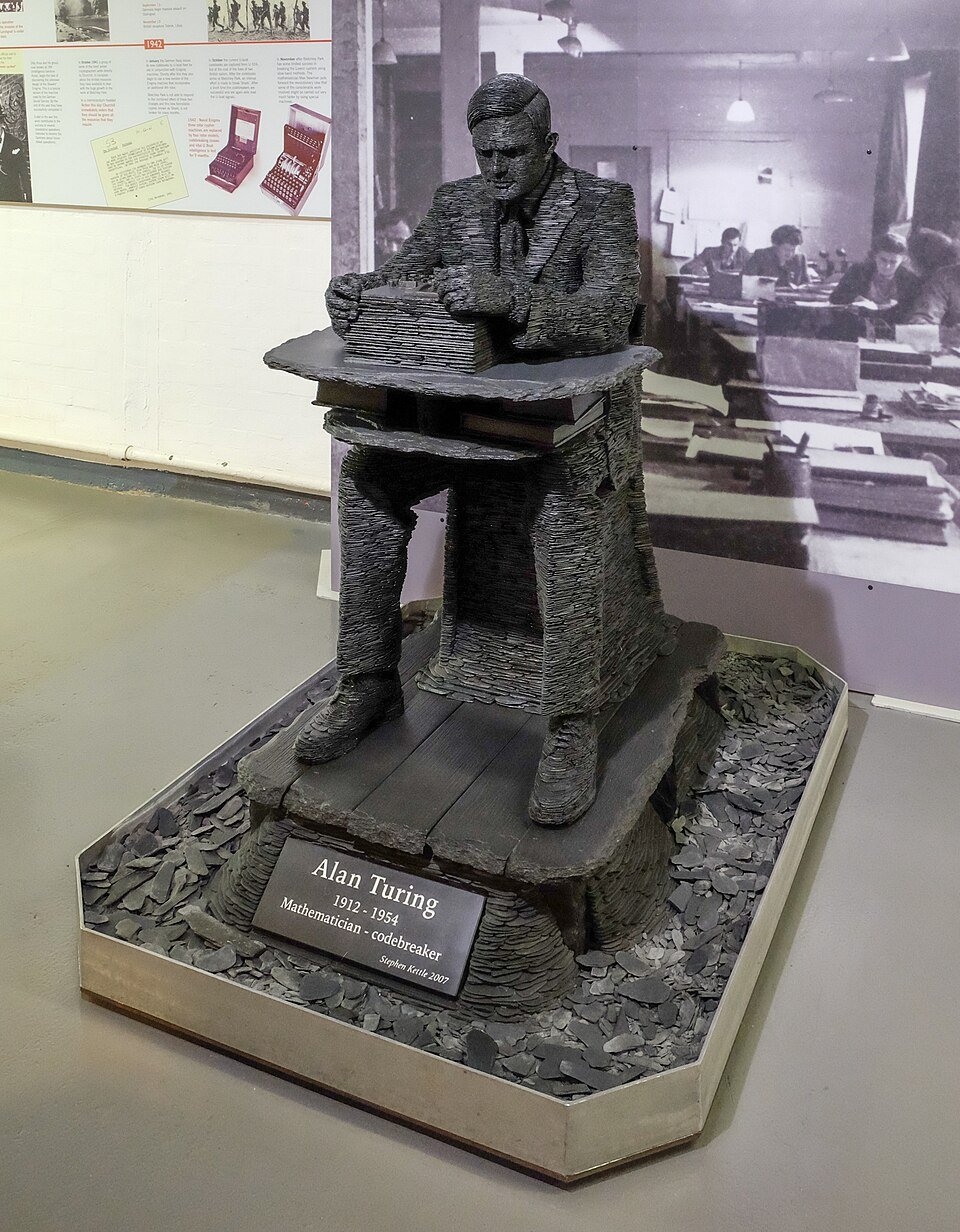
Who they were
A Cambridge mathematician, Turing published On Computable Numbers in 1936, defining the abstract machine — now called a Turing machine — that fixed the limits of what any computer can calculate. During the Second World War he worked at Bletchley Park, where he designed the bombe machines central to breaking the Enigma ciphers, including the naval traffic of the Atlantic war.
What they did
After the war he designed the ACE computer at the National Physical Laboratory and worked on the Manchester computers; his 1950 paper proposed the imitation game, now the Turing test, as a criterion for machine intelligence, and his late work founded the mathematics of biological pattern formation. In 1952 he was convicted of gross indecency for a relationship with a man and accepted hormone treatment as an alternative to prison; his security clearance was withdrawn. He died in 1954 of cyanide poisoning, recorded by the inquest as suicide.
Legacy
Turing is regarded as a founder of computer science and artificial intelligence, honoured in the Turing Award, computing’s highest prize. The British government apologised for his treatment in 2009, a royal pardon followed in 2013, and the 2017 law informally named for him pardoned thousands convicted under the same statutes. His face now appears on the Bank of England’s 50-pound note.