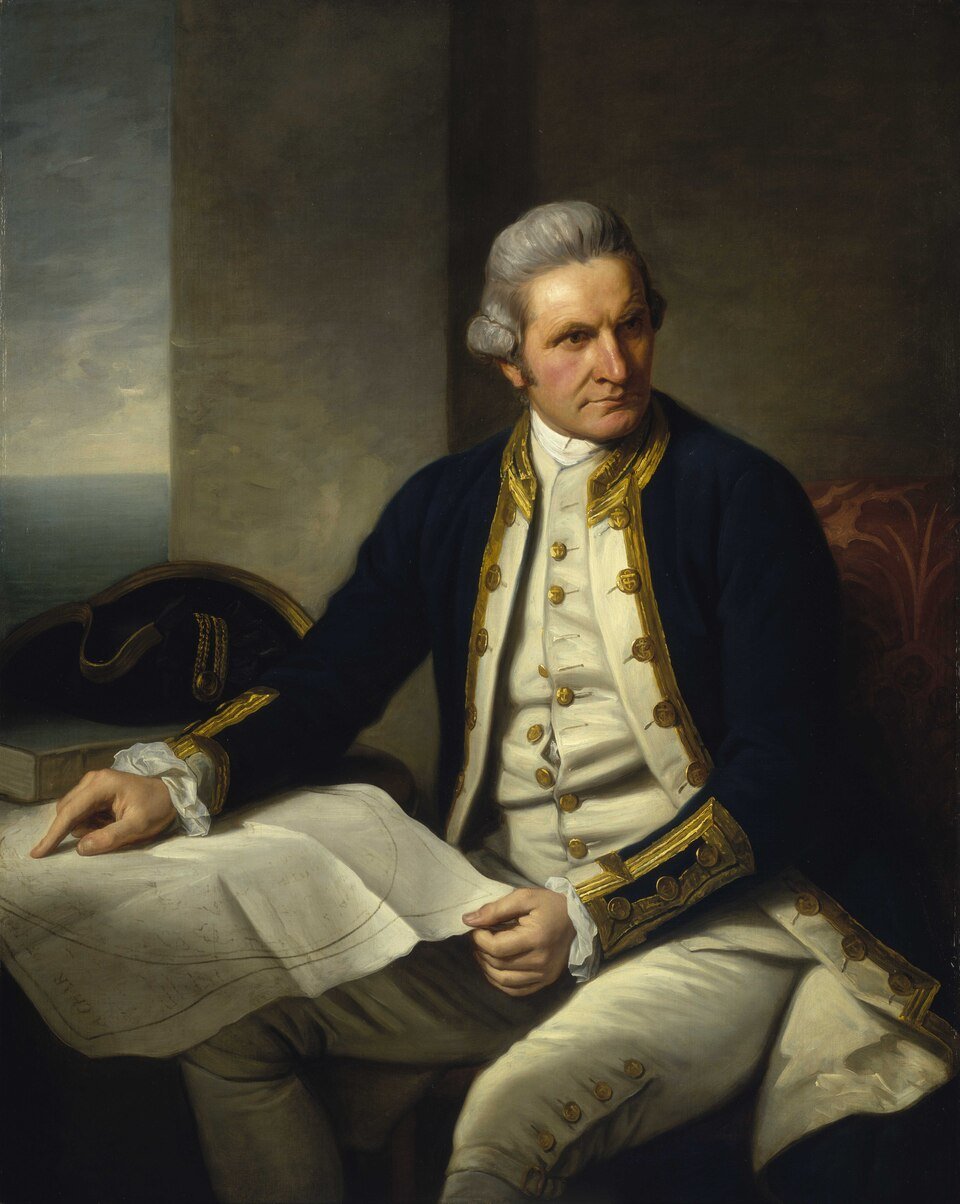
Who they were
The son of a Yorkshire farm labourer, Cook learned seamanship in North Sea colliers, joined the Royal Navy in 1755, and made his name surveying the St Lawrence River and Newfoundland with a precision that brought him to the Admiralty’s attention.
What they did
Commanding the Endeavour from 1768, he observed the transit of Venus at Tahiti, circumnavigated and charted New Zealand, and mapped Australia’s east coast, claiming it for Britain as New South Wales. His second voyage (1772–1775) crossed the Antarctic Circle and disposed of the myth of a vast southern continent, while his shipboard regime showed scurvy could be kept at bay. The third voyage searched for a Northwest Passage and reached Hawaii, where on 14 February 1779 Cook was killed in a violent confrontation with Hawaiians at Kealakekua Bay after a dispute over a stolen boat.
Legacy
Cook’s charts set new standards of accuracy and opened the Pacific to European contact. In Australia, New Zealand and the Pacific islands that contact brought colonization and its consequences for indigenous peoples, and his monuments and anniversaries are now the subject of open debate — assessments historians frame as a question of what followed in his wake as much as of the man himself.