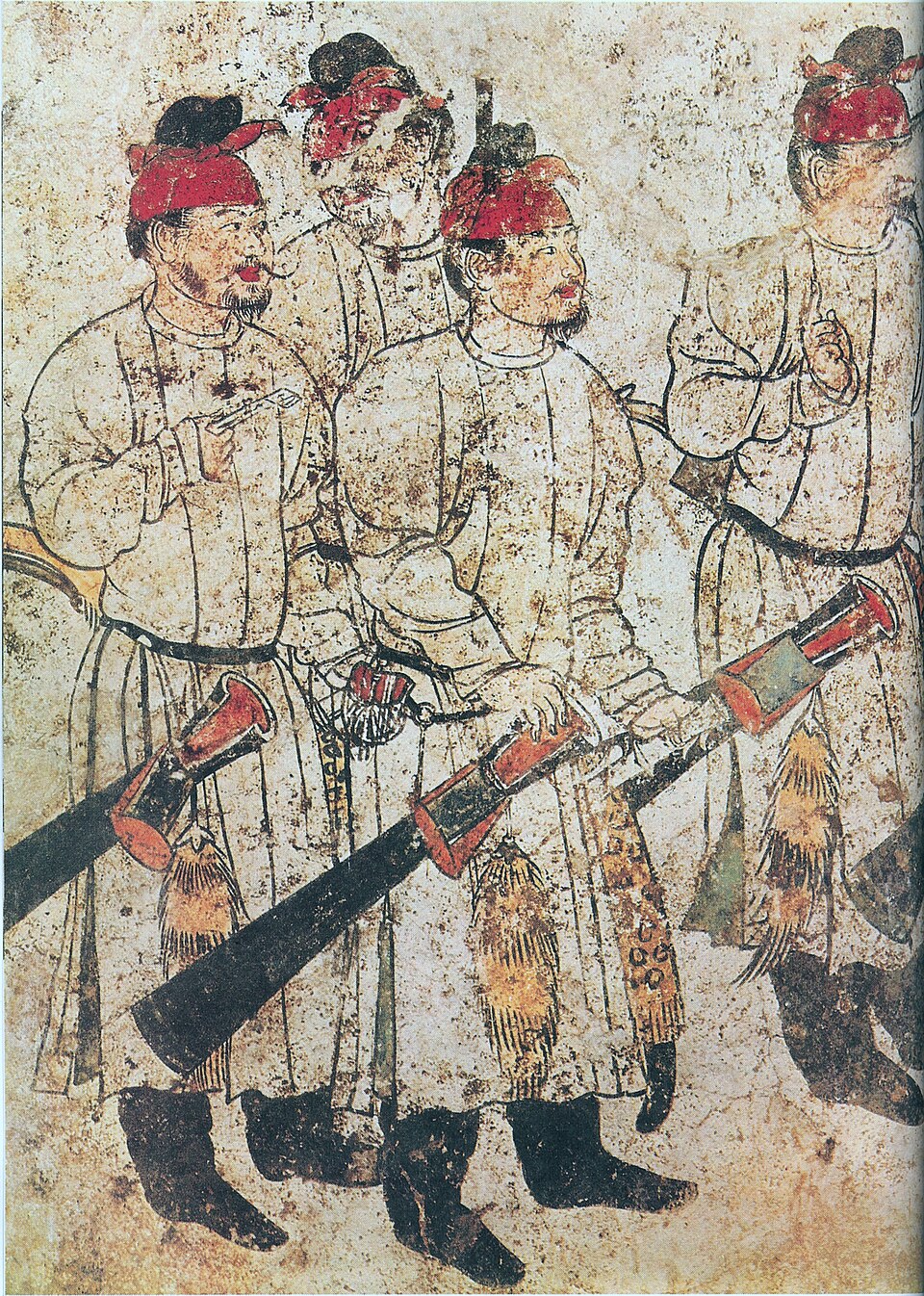
Overview
The collar is a narrow band closed with a button or tie at the right shoulder, so the neck is enclosed rather than crossed; the body is cut straight and full, the sleeves narrow for riding or wide for office. Colour was the rank marker under the Tang — purple for the top three grades, then scarlet, green and blue — and later dynasties added the rank badge to the same shape. A slit at the knee, or an inserted panel called the lanshan, distinguishes the scholarly version.
How it is worn
It is worn over an inner robe, belted at the waist with a leather belt whose plaques also show rank, and with soft boots and a futou headwrap. Because the collar closes high and the belt sits firm, the silhouette is upright and narrow, which is what separates it from the loose draped robes it displaced. The same garment served for court, riding and the street, changed only by sleeve width and cloth.
History
The round collar reaches China along the Silk Road from Central Asia and Persia, becomes fashionable under the Northern dynasties, and is the standard by the early Tang for men of every class and for women wearing men’s dress. Song, Ming, Korea and Vietnam all built their official uniforms on it, and it outlasted the Tang by nine hundred years. The Qing replaced it with Manchu forms, and the hanfu revival has made it the most-reconstructed men’s robe.