Overview
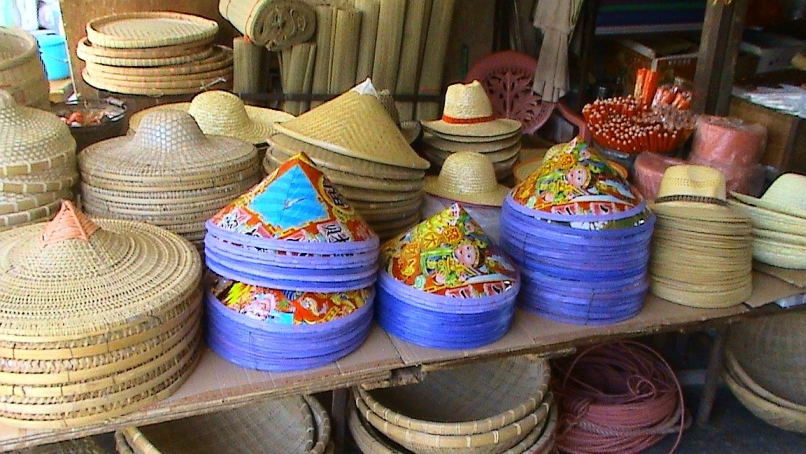
It is woven from split bamboo, rattan or straw, sometimes in two layers with leaves laid between them for waterproofing, and the cone is wide enough to shed rain clear of the shoulders. Inside is a woven ring that sits on the head and holds the brim away from it, with a chin cord to keep it on in wind. There is no fixed size: a field hat is broad and shallow, a travelling hat narrower and deeper, and a rain hat has the tightest weave.
How it is worn
It rests on the head ring rather than on the crown, which is what makes it bearable for a day’s work, and is tied under the chin or at the nape. Because the brim is stiff, it is also a fan, a basket and something to sit on. Worn low it hides the face entirely, and Chinese fiction has used that so consistently that a lowered douli now reads as a person who does not want to be recognised.
History
Conical hats appear in Chinese sources from the Han onward and never really change, because there is not much to improve; they spread to Korea, Japan, Vietnam and Thailand, where the nón lá and the sedge hat are local answers to the same problem. Song painting is where the type becomes the standard shorthand for the countryside. It is still worn for field work across the region, and is one of the very few garments here that is neither historical nor revived.