Overview
At unification, Egyptian dress becomes a system of rule. The garments themselves stay simple — wrapped linen, much as in the Predynastic — but the king acquires a set of items whose whole purpose is to say what he is, and those items barely change for three thousand years afterwards.
Key garments and style
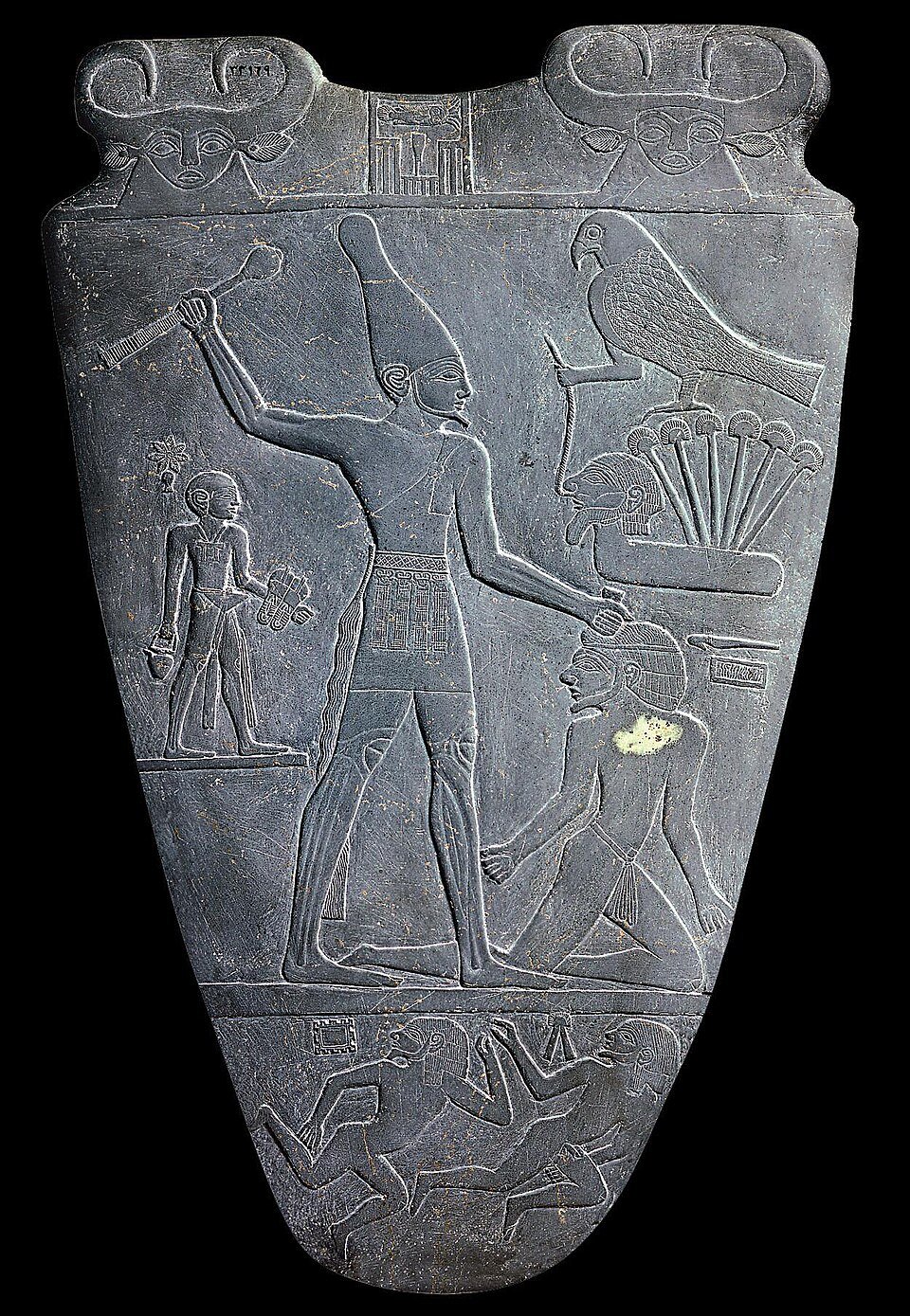
Men wore the shendyt, a linen kilt wrapped and knotted at the waist; women a close sheath dress with straps. What is new is royal apparatus: the tall White Crown of Upper Egypt, the Red Crown of Lower Egypt, and the two combined into the Double Crown that states the union as an object. With them go the ceremonial false beard, strapped on, and the bull’s tail hung at the back of the belt.
The Narmer Palette is the founding image of the system, showing the king in the White Crown on one face and the Red on the other — dress used as an argument about sovereignty.
The period also holds the oldest woven garment known anywhere. The Tarkhan dress, a pleated linen shirt with sleeves recovered from a cemetery south of Cairo, has been radiocarbon-dated to the late fourth millennium BC, so an actual Early Dynastic garment survives rather than only pictures of one.
Transition
The Old Kingdom took this vocabulary and refined it, adding finer pleating, elaborate wigs and the broad bead collar as the standard equipment of rank.