Overview
The Middle Kingdom restored a single court standard after the provincial centuries, and its dress is marked by sobriety rather than display: longer, plainer garments, restrained lines, and an intensity of craft that went into jewellery instead. It is the period whose ornament, not whose clothing, is the high point.
Key garments and style
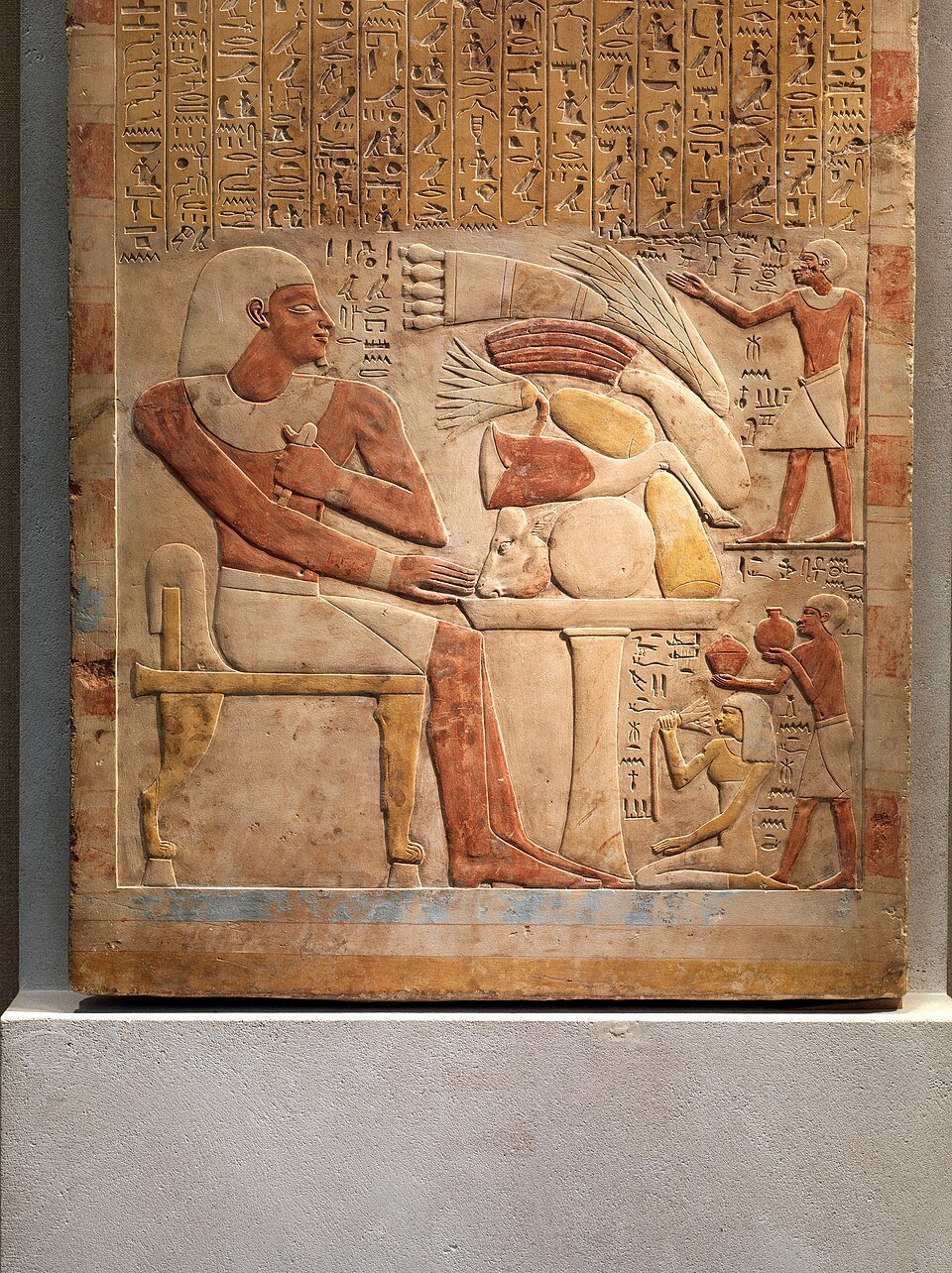
Men’s kilts lengthen, often to mid-calf, and are worn wrapped and knotted, sometimes with a stiffened triangular front on formal figures; a long garment covering the chest appears for officials. Women wear the narrow ankle-length sheath with shoulder straps, shown so tight in art that it is plainly a convention rather than a description of cut. Linen remained the only significant fibre.
The jewellery is another matter. The pectorals from the royal women’s burials at Dahshur and Lahun — openwork gold cloisonné set with carnelian, turquoise and lapis, built around the king’s name — are among the finest objects Egypt ever produced, and they were made to be worn on the body rather than buried as models. Broad collars, girdles of gold cowrie shells with pebbles inside to sound as the wearer moved, and heavy anklets belong to the same wardrobe.
Tomb models of workshops and estates, of the kind found in the tomb of Meketre, show weavers at horizontal ground looms and the plain working kilts of the people using them.
Transition
In the Second Intermediate Period the vertical loom arrived with the Hyksos, and the wider cloth it produced made possible the voluminous pleated dress of the New Kingdom.