Overview
Egypt after the Arab conquest kept doing what it had done since the pharaohs — growing flax and weaving linen — and became, under Islamic rule, one of the great textile producers of the medieval world. Its dress is the general Islamic wardrobe of tunic, robe and turban, and its distinction is the cloth itself.
Key garments and style
Men wore a long tunic under a wider robe, belted or loose, with a wound turban; women wore layered gowns at home and a wrap and face veil outside. Coptic Christians continued older local forms, and dress at various periods marked religious community by prescribed colours.
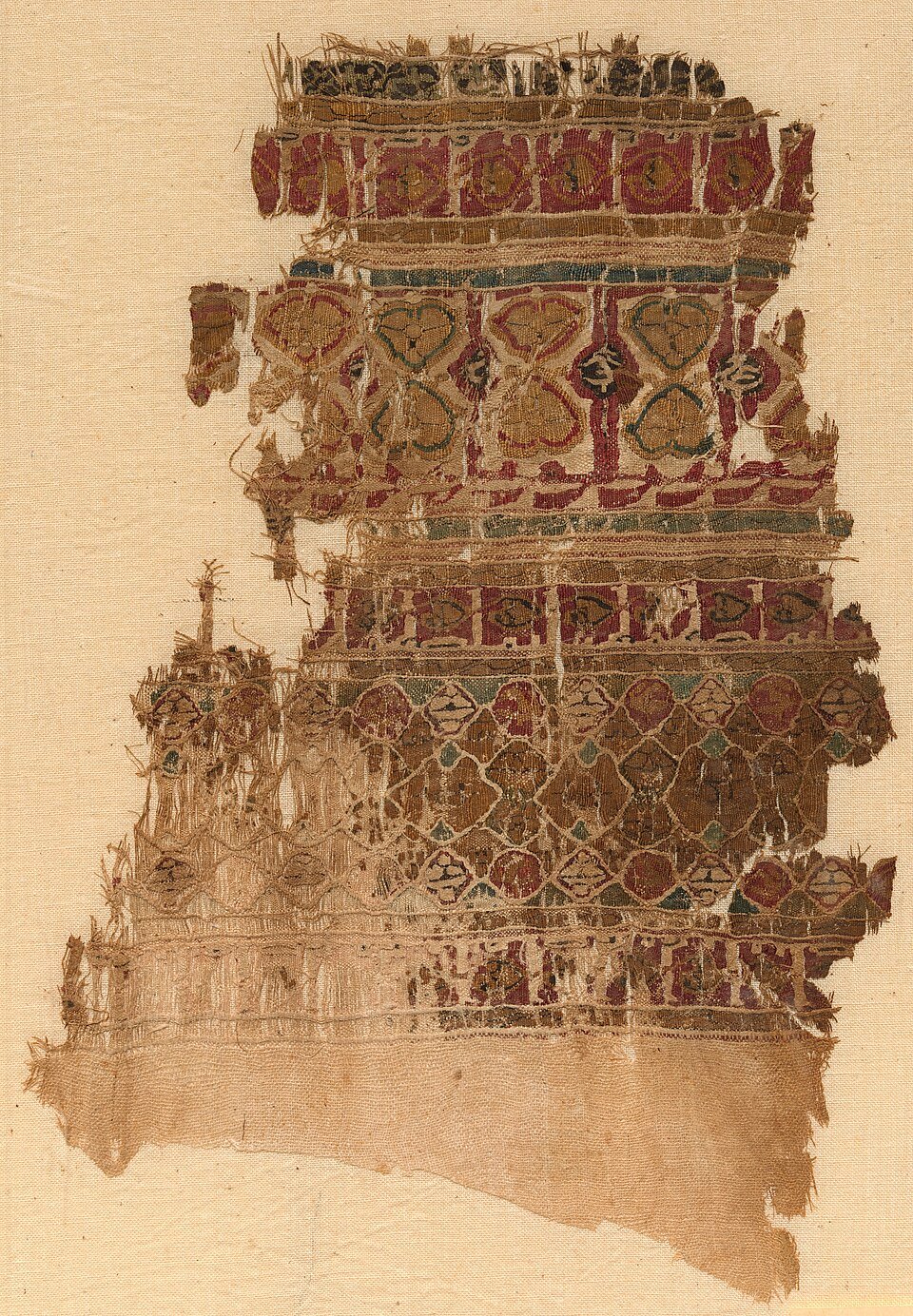
Tiraz was the state industry. Inscribed bands naming the ruler were woven into cloth in government workshops, at Tinnis and Damietta above all, and robes bearing them were given as honours — so a garment could carry the caliph’s name across the body of whoever received it. Fatimid tiraz linens survive in quantity because Egypt’s dry ground preserved them.
The other Egyptian peculiarity is documentary. The Cairo Geniza preserved thousands of everyday papers, including trousseau lists that itemise a bride’s clothes by garment, colour and value — so for once medieval clothing can be counted and priced rather than only pictured.
Transition
Under the Mamluks the military elite imposed a court style of heavy robes and graded headgear on top of this, and Cairo remained a textile capital.