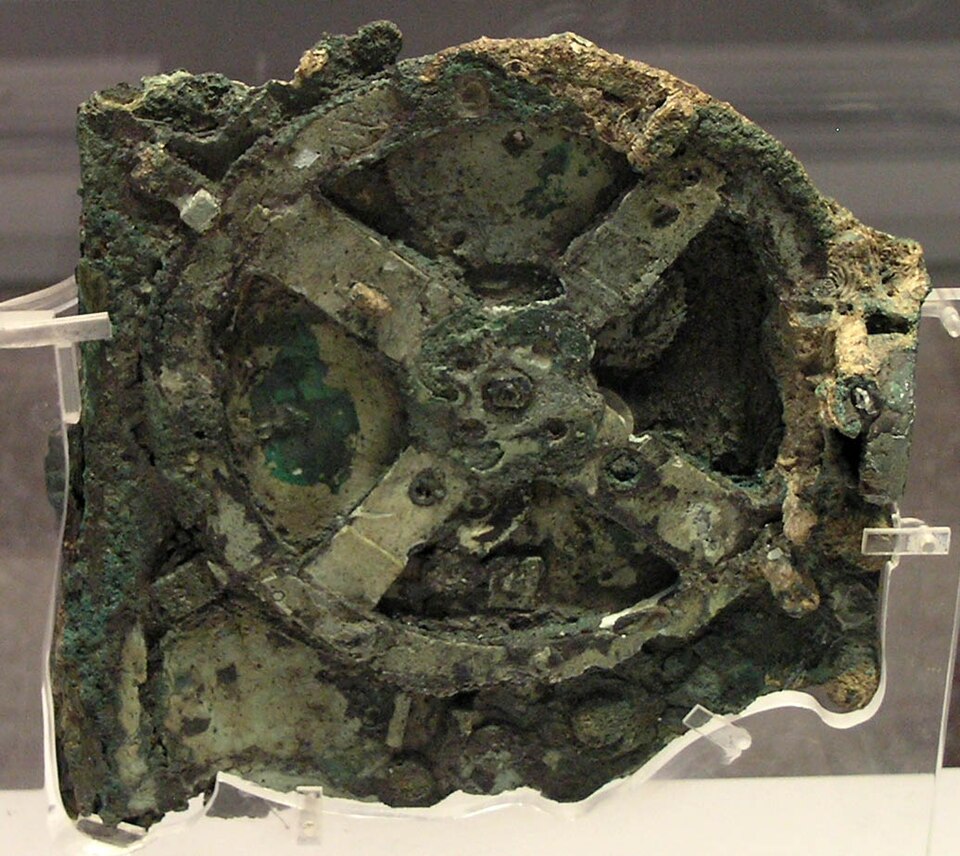
Overview
The Antikythera Mechanism is a bronze mechanical calculator of the heavens, generally dated between the 2nd and 1st centuries BC. Sponge divers found its corroded fragments in 1901 among the cargo of a ship that sank off the island of Antikythera around the 60s BC, and the surviving pieces are kept in the National Archaeological Museum in Athens.
Description
Some eighty fragments preserve at least thirty interlocking gearwheels, dials and inscribed scales. X-ray and CT studies, above all by the international research team working since the 2000s, indicate that the device tracked the sun and moon through the zodiac, predicted eclipses using the Saros cycle, modelled the moon’s varying speed with a pin-and-slot gear, and counted down to games such as the Olympics; many researchers hold that it also displayed the five planets known in antiquity, though those parts are largely lost. Who built it, and where — Rhodes, Corinth’s colonies and Pergamon have all been proposed — remains unresolved.
History and legacy
The mechanism’s complexity astonished researchers: nothing of comparable intricacy survives until the astronomical clocks of medieval Europe, more than a thousand years later. It reshaped the understanding of ancient Greek engineering and astronomy, showing that scholars of the Hellenistic world could turn geometric planetary theory into precision gearwork.