Overview
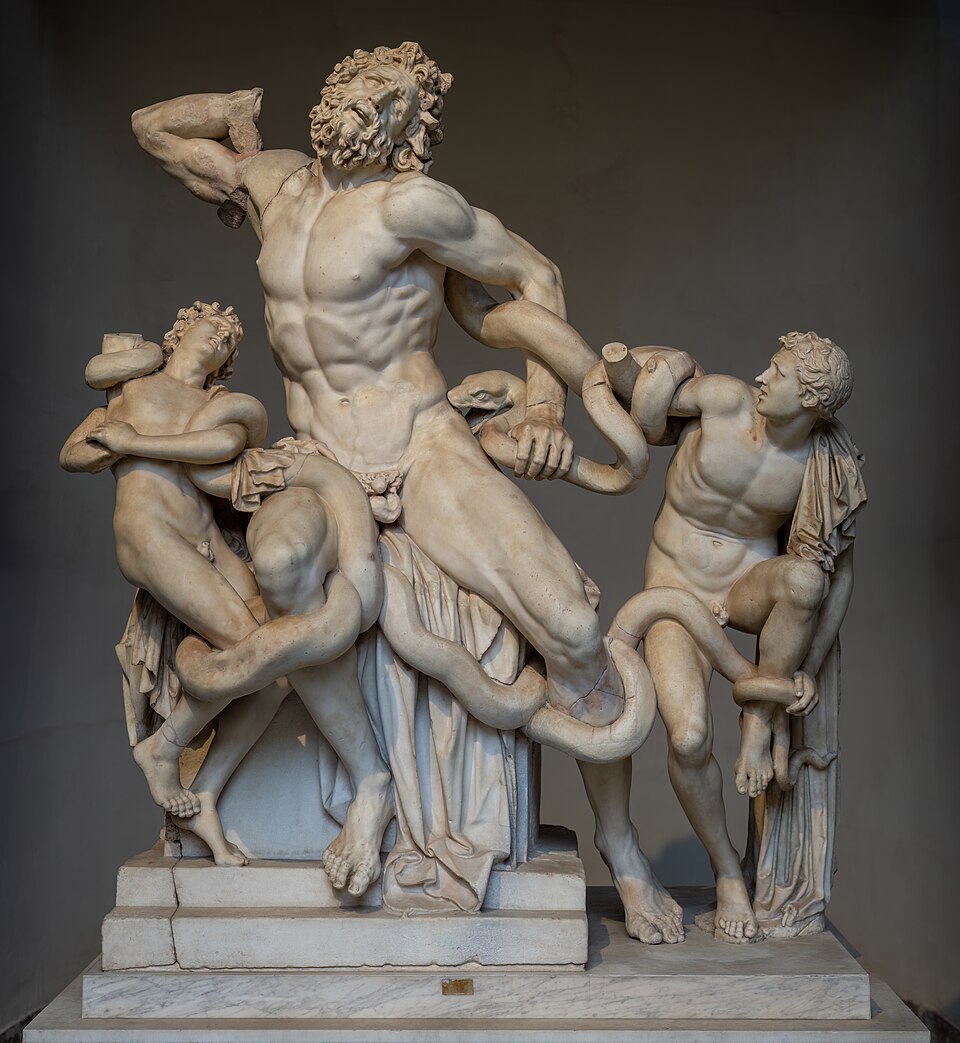
Laocoön and His Sons is a monumental marble group depicting the Trojan priest Laocoön and his sons in the coils of two sea serpents, the punishment described in the legend of the Trojan horse. The Roman writer Pliny the Elder praised it as the work of the Rhodian sculptors Agesander, Athenodoros and Polydorus, and its dating — an original of the Hellenistic age or a later marble of the early Roman era — is still debated, roughly between 200 and 30 BC.
Description
The composition binds three writhing figures and the serpents into a single pyramid of struggle. Laocoön’s straining torso and anguished face carry the pathos of the Hellenistic baroque style to its peak, and the group was carved to be seen from the front like a relief brought to life.
History and legacy
The group was unearthed in a Roman vineyard on the Esquiline hill in 1506 and immediately acquired by the pope; Michelangelo studied it closely, and its influence runs through Renaissance and Baroque sculpture. The 18th-century debate between Winckelmann and Lessing over its restrained agony helped found modern art criticism. It remains a centrepiece of the Vatican Museums.