Overview
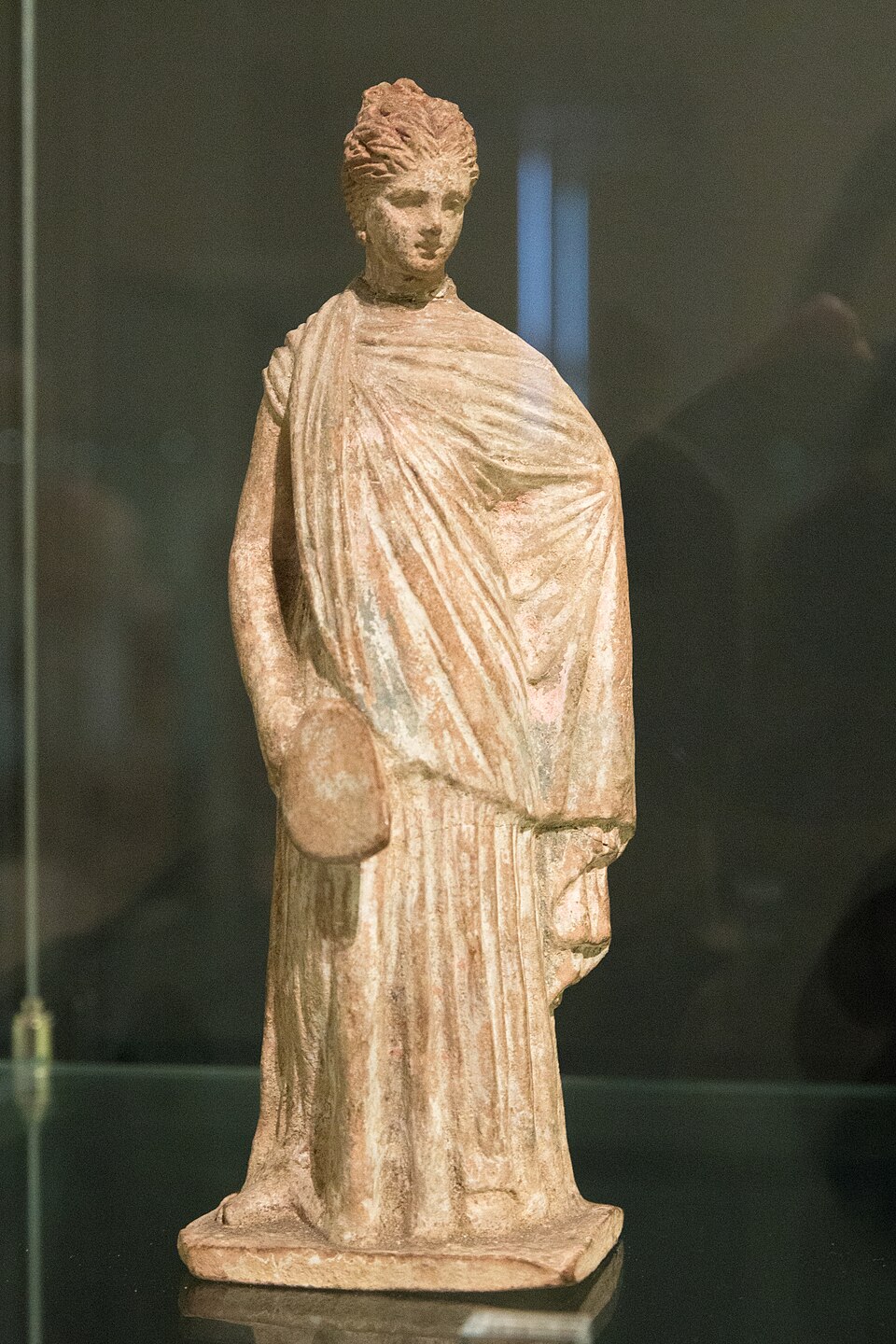
Nothing about the pieces is new — a rectangular tunic pinned or sewn at the shoulders, a rectangular mantle over it — but the handling is. Cloth is lighter and more plentiful, so a mantle can be wound twice around the body and over one shoulder, pulled up behind the head, and held closed from inside; the resulting silhouette is a column with a single arm emerging. Women’s figures from Tanagra and Myrina show it in dozens of variations, often with a broad sun hat and a fan, and the same drapery appears on statues from Alexandria to Bactria.
How it is worn
The chiton is put on and belted, sometimes twice, high under the bust and again at the hips. The himation is the part that takes practice: it is wound from the back around the right side, across the front, and over the left shoulder or arm, and it stays put by tension and by the wearer’s hand holding it from within. Because the mantle covers the arms, gesture is made with the whole shape, and Hellenistic sculpture uses the drapery itself as the expression — the reason so many statues read as movement in cloth.
History
The style travelled with Greek settlement and became the visual dress of an educated class from Egypt to the Indus, worn by people who were not Greek by descent. Rome adopted the mantle for the pallium, the dress of philosophers and later of Christian clergy; Gandharan sculpture put it on the Buddha. It is one of the few wardrobes that survived its own civilisation by becoming a costume for an idea.