Overview
Alexander’s conquests turned a set of city-state wardrobes into the dress of a world stretching from the Adriatic to the Indus, and the effect was less that Greek clothing changed than that it travelled. The same chiton and himation now had to work in Alexandria, Antioch and Bactria, worn by people who were Greek by education rather than birth — and dressing Greek became a way of claiming that status.
Key garments and style
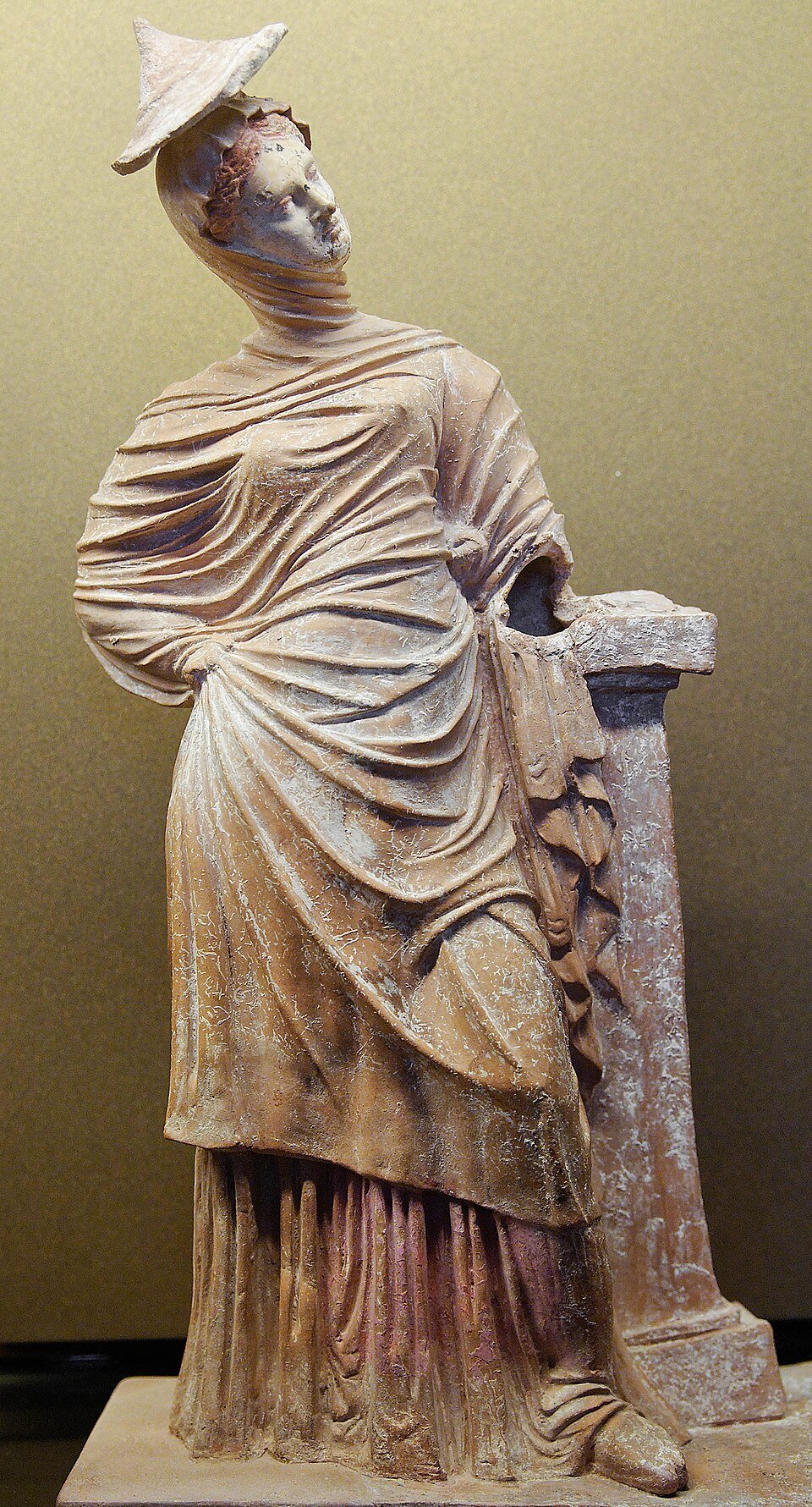
The garments stay the ones the Archaic and Classical periods established; what changes is handling. Cloth is finer and more transparent, and the himation is wound in increasingly elaborate arrangements, wrapped high under the arms, drawn over the head, pulled taut across the body so the chiton reads through it. The Tanagra figurines — small painted terracottas of standing women, exported all over the Mediterranean — are the best record of this, and they show the mantle doing nearly all the work while the tunic beneath it barely varies.
For men the practical items spread with the armies: the chlamys and the broad-brimmed petasos become the traveller’s and soldier’s kit across the whole Hellenistic world. Kings are marked by the plain cloth diadem rather than by any distinctive garment, which is a Macedonian habit that outlasted Macedon.
Transition
Roman annexation did not displace this dress, because Rome had been absorbing it for generations already. Greek draping fed directly into the Roman palla and pallium, and in the Greek-speaking east the himation continued essentially unbroken into Roman and then Byzantine use.