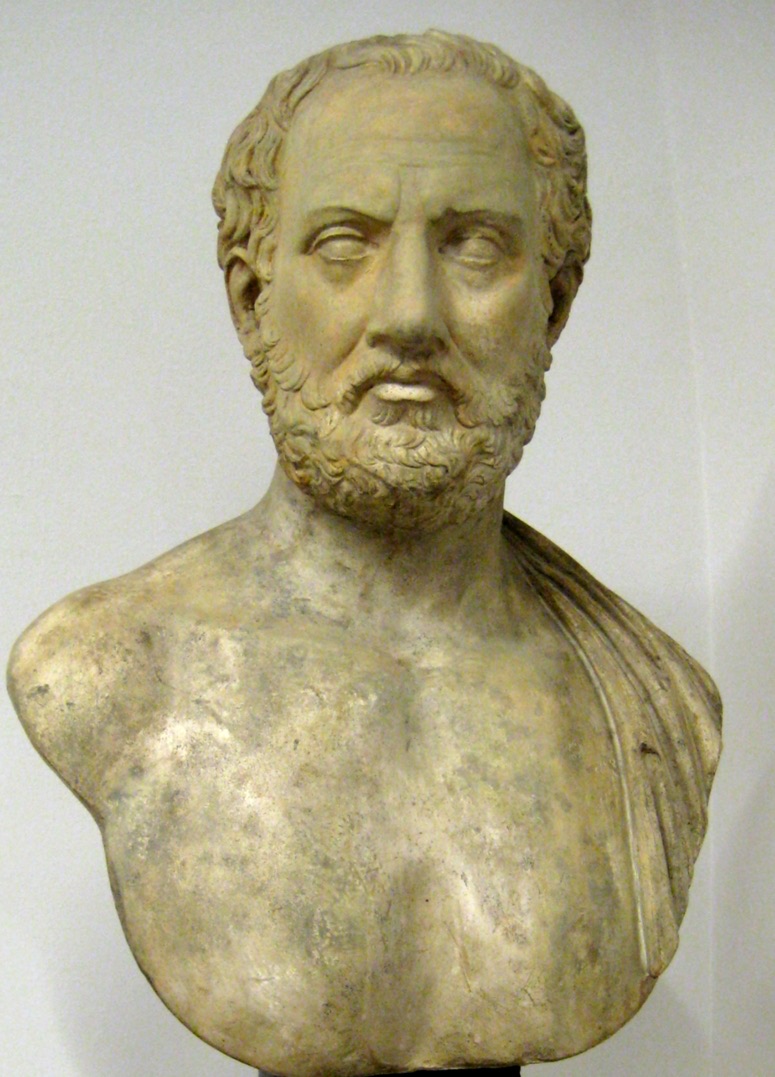
Who they were
Thucydides (c. 460–c. 400 BC) was an Athenian general and the historian of the Peloponnesian War. He caught the plague that struck Athens and survived; his clinical description of it is famous. As a general he failed to save Amphipolis from Brasidas in 424 BC and was exiled for twenty years — by his own account, the exile let him observe the war from both sides.
What they did
He wrote the History of the Peloponnesian War, left unfinished and breaking off mid-sentence in 411 BC; Xenophon’s Hellenica picks up the story. He stated his standards of evidence — his own observation and cross-examined eyewitnesses — while the speeches, by his own admission, are reconstructed to fit what each occasion called for. He excluded the mythical, aiming, as he put it, at a possession for all time rather than a prize-piece for the moment. His analysis made power, fear, and interest the drivers of events: the judgment that Sparta was driven to war by fear of Athens’ growth, and the Melian Dialogue on the strong and the weak, are his set-pieces.
Legacy
Thucydides is often called the founder of scientific history and of political realism. He is read continuously in war colleges and in political theory, and the coinage of a Thucydides trap in modern debate shows his afterlife.