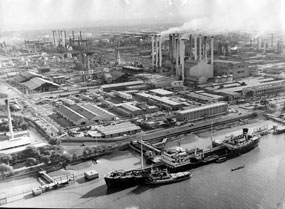
What it was
The company originated in William Knox D’Arcy’s concession of 1901: oil was struck at Masjed Soleyman in 1908 — the first major oil discovery in the Middle East — and the Anglo-Persian Oil Company was founded in 1909, renamed Anglo-Iranian in 1935. In 1914, on Churchill’s initiative to secure fuel for the Royal Navy, the British government bought a controlling stake, making it a private company entwined with a foreign state.
Role
The company built the Abadan refinery — for decades among the largest in the world — along with company towns, but the conditions of its Iranian workers and Iran’s small share of the profits, a fraction of what the company paid to the British treasury alone, became standing grievances. A renegotiation under Reza Shah in 1933 extended the concession on terms still widely judged unfavorable. The company’s refusal of 50-50 profit-sharing proposals of the kind conceded elsewhere in the region hardened Iranian opinion, and in 1951 the Majlis under Mohammad Mosaddegh nationalized the oil industry. Britain answered with an embargo and a blockade.
Fate
After the 1953 coup, a Western consortium took over operations, with the company holding 40 percent; it renamed itself British Petroleum in 1954. Iran’s oil was fully nationalized after 1979. The company is often cited as the archetypal case of a concession company shaping — and destabilizing — a host country’s politics.