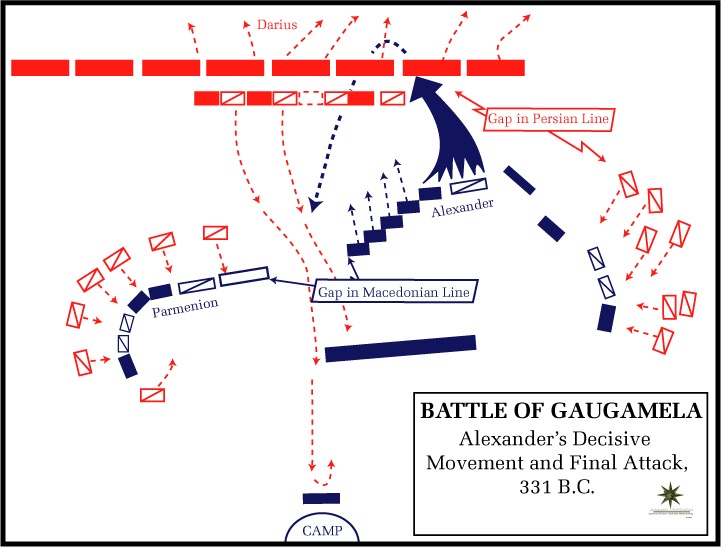
What happened
On 1 October 331 BC — a date well established from a Babylonian astronomical diary — Alexander the Great decisively defeated Darius III on a plain near Gaugamela, in what is now northern Iraq. Alexander advanced obliquely, drew the Persian cavalry outward, and led his Companion cavalry into the resulting gap, straight toward Darius himself. The scythed chariots failed against ranks that opened to let them through, and although the Persian left had broken deep into the Macedonian camp, the army’s cohesion collapsed once Darius fled the field.
Background
After Issus in 333 BC and Alexander’s conquest of the Levant and Egypt, Darius III assembled a vast royal army drawn from across the empire. Ancient figures are wildly inflated; modern estimates put the Persians at perhaps 50,000–100,000 against some 47,000 Macedonians. Darius chose flat ground suited to his cavalry and scythed chariots.
Consequences
Babylon and Susa surrendered with their treasuries, and Persepolis fell soon after. Darius fled east and was murdered by his satrap Bessus in 330 BC. The battle was effectively the end of the Achaemenid Empire and the start of Macedonian rule in Iran, and it is often cited among the decisive battles of world history.