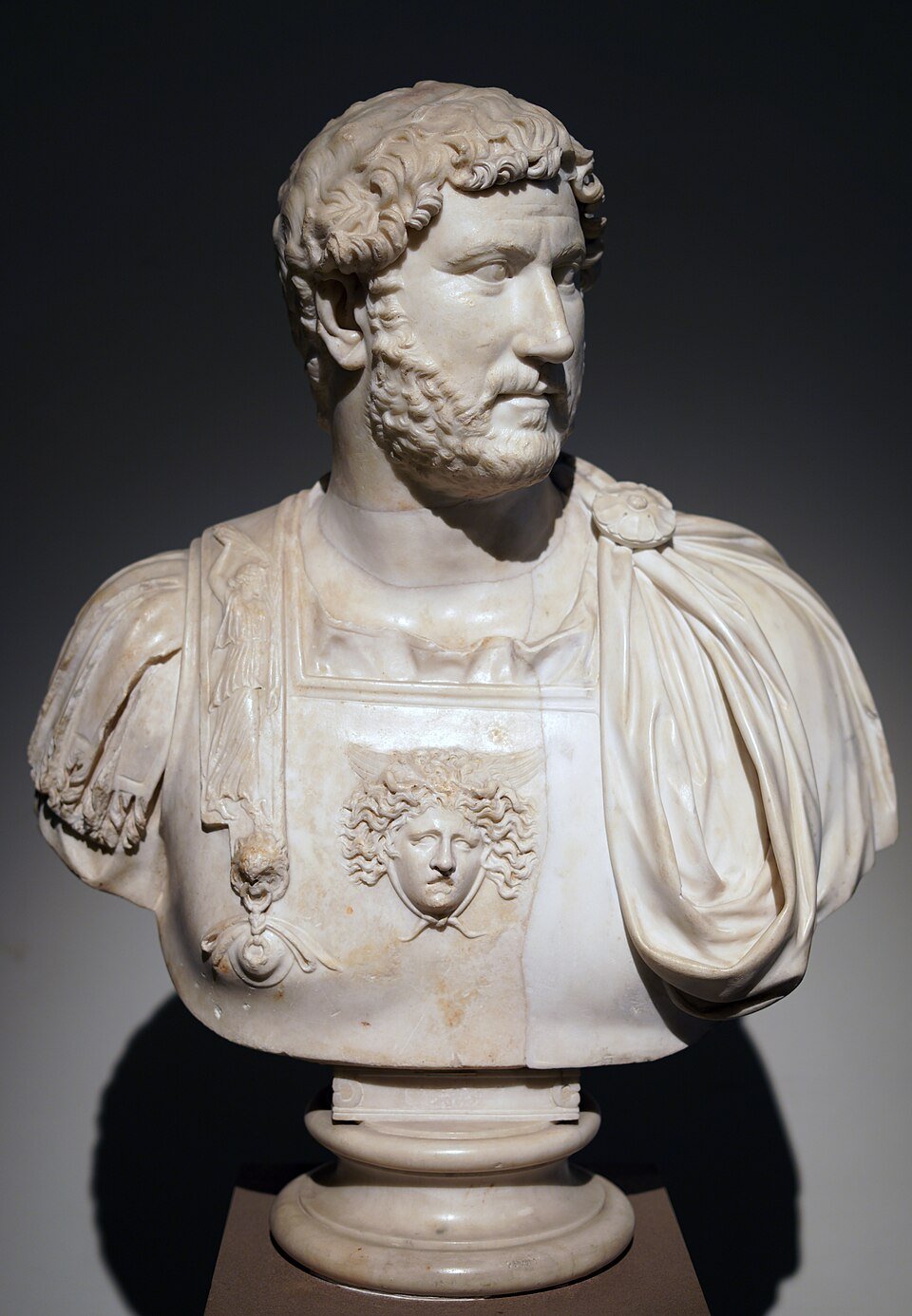
Who they were
Hadrian was Roman emperor from 117 to 138, Trajan’s ward and successor, from the same Italica background in Roman Spain. A restless administrator with a passion for Greek culture, he spent more than half his reign traveling the provinces.
What they did
He gave up Trajan’s Mesopotamian conquests to stabilize the frontiers. In Britain he began Hadrian’s Wall in 122, an eighty-mile barrier marking the empire’s northern edge; in Rome he rebuilt the Pantheon, and at Tivoli he built a vast villa. He harshly suppressed the Bar Kokhba revolt in Judea (132–136), a war with enormous loss of life. After the death of his companion Antinous in the Nile in 130, he had him deified and cities and cults founded in his memory. He arranged the succession by adopting Antoninus Pius on condition that Antoninus adopt Marcus Aurelius.
Legacy
Counted among the so-called Five Good Emperors, he is remembered as the emperor who chose consolidation over conquest. His wall, the Pantheon, and the villa at Tivoli are among the most famous Roman monuments, and his mausoleum survives as Castel Sant’Angelo; Marguerite Yourcenar’s Memoirs of Hadrian keeps him alive in the modern imagination.