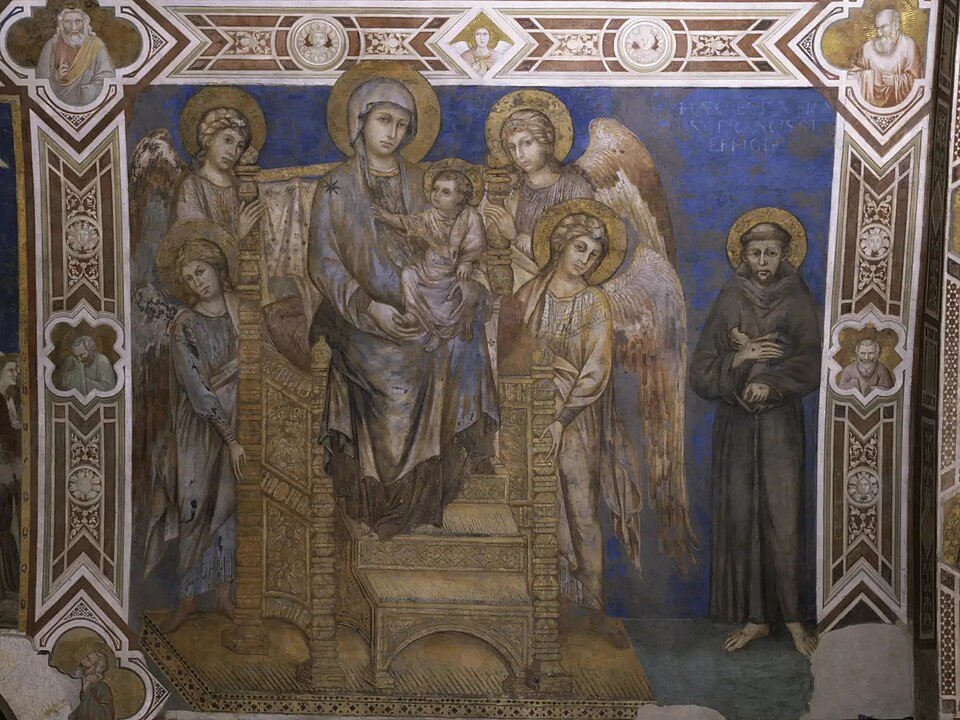
Who they were
Francis was born around 1181 in Assisi, in Umbria, the son of a wealthy cloth merchant. After imprisonment in a war with neighboring Perugia and a long illness, he renounced his inheritance around 1206 to live in poverty among the poor and to restore ruined churches.
What they did
Followers gathered around him, and around 1209 Pope Innocent III approved his simple rule of life, from which the Franciscan order grew with remarkable speed across Europe. With Clare of Assisi he helped found a parallel order for women, the Poor Clares. In 1219 he traveled to Egypt during the Fifth Crusade and met the sultan al-Kamil, a meeting recorded by contemporaries. In 1224, contemporaries reported that he received the stigmata, the wounds of the crucifixion. He died in 1226 and was canonized only two years later.
Legacy
The Franciscans reshaped medieval religious life, preaching in towns rather than withdrawing from them. The basilica built at Assisi, with its celebrated fresco cycles, became a major pilgrimage site. Francis is a patron saint of Italy, is widely associated with care for animals and nature, and was named patron of ecology in 1979; in 2013 Pope Francis became the first pope to take his name.