Overview
The Roman Empire, dating from 27 BC, began when Augustus founded the Principate, opening some two centuries of relative peace and prosperity known as the Pax Romana. Ruled from Italy as its center, it governed the whole Mediterranean world.
Key developments
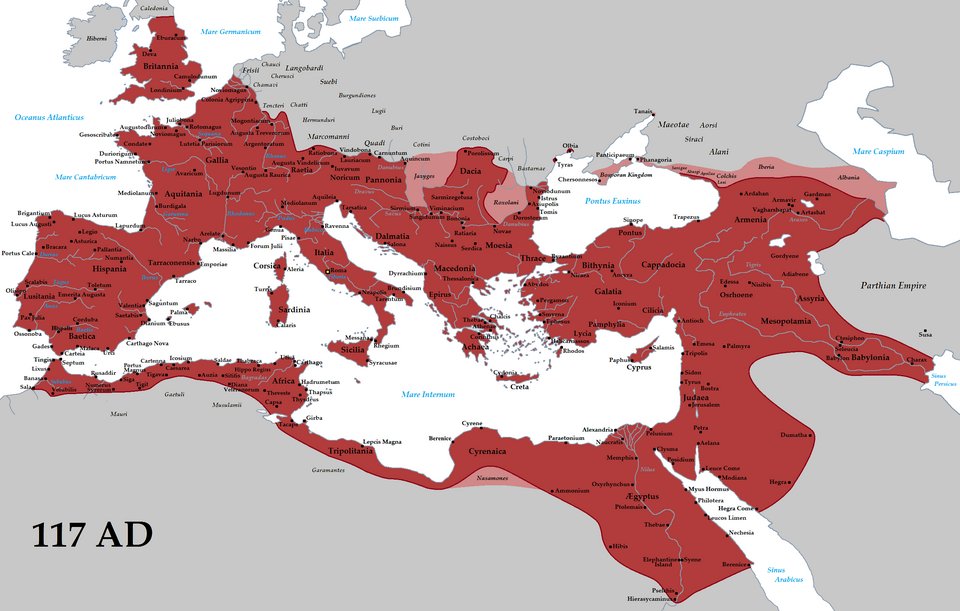
After the Julio-Claudian emperors (Tiberius, Caligula, Claudius, Nero) and the Flavians, who built the Colosseum, the empire reached its greatest extent under Trajan, about AD 117, and enjoyed the era of the “Five Good Emperors,” ending with Marcus Aurelius. The turbulent third century was followed by the reorganizations of Diocletian. Constantine legalized Christianity with the Edict of Milan in 313 and founded Constantinople in 330; Christianity became the state religion under Theodosius late in the 4th century.
End and transition
The empire was permanently split into western and eastern halves in 395. Under barbarian pressure and internal decay the West declined, and Rome was sacked in 410 and 455. The last western emperor, Romulus Augustulus, was deposed in 476, the conventional end of the Western Roman Empire. The eastern (Byzantine) empire continued for another thousand years.