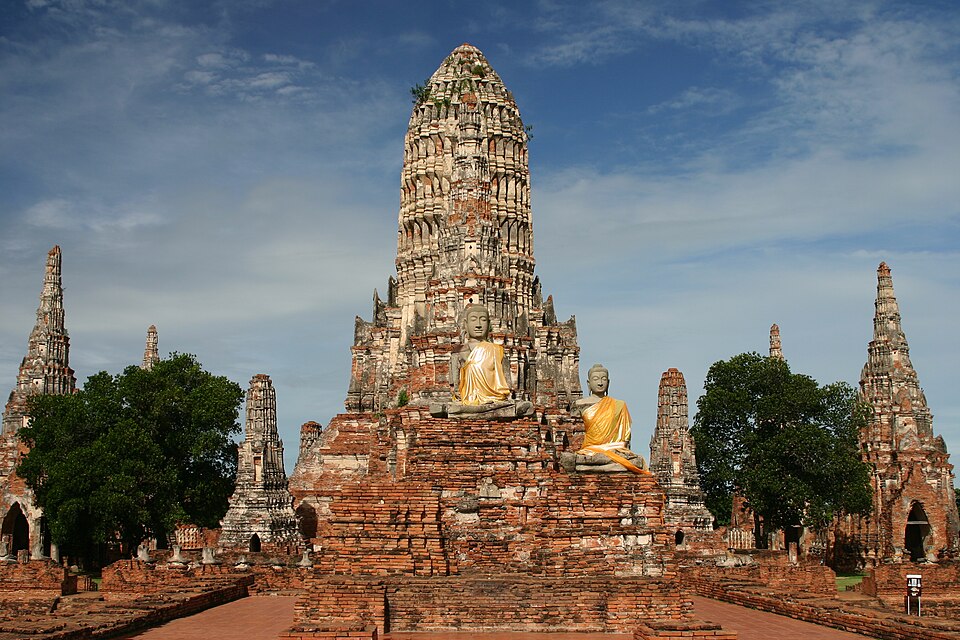
Overview
Founded in 1351 (chronicle dating) by U Thong, who was crowned Ramathibodi I, Ayutthaya rose from its river-island capital to dominate Siam for more than four centuries. It became one of Asia’s great trading cities; by around 1700 it ranked among the largest cities in the world, with estimates often cited near a million inhabitants.
Key developments
The kingdom absorbed Sukhothai in 1438 and sacked Angkor in 1431, as commonly dated. Its defining rivalry was with Burma: the city fell to Bayinnaung’s Burmese armies in 1569 and remained a vassal until Naresuan restored independence, declaring it in 1584 and sealing it with his elephant-duel victory of 1593. The seventeenth century brought a cosmopolitan golden age, when Chinese, Japanese (the Japanese quarter headed early in the century by Yamada Nagamasa), Persian, Portuguese, Dutch and French communities thrived; under Narai (r. 1656–1688) it peaked, with embassies exchanged with Louis XIV’s France. After Narai, the turn of 1688 expelled the French garrison and curtailed Western ties, though trade with Asia continued.
End and transition
Renewed Burmese invasions by the Konbaung dynasty came in 1760 and again in 1765–67. On April 7, 1767 the city fell and was burned; temples, palaces and records were destroyed. Power fragmented until Taksin reunified Siam from Thonburi. The ruins, as Ayutthaya Historical Park, became a UNESCO World Heritage site in 1991.