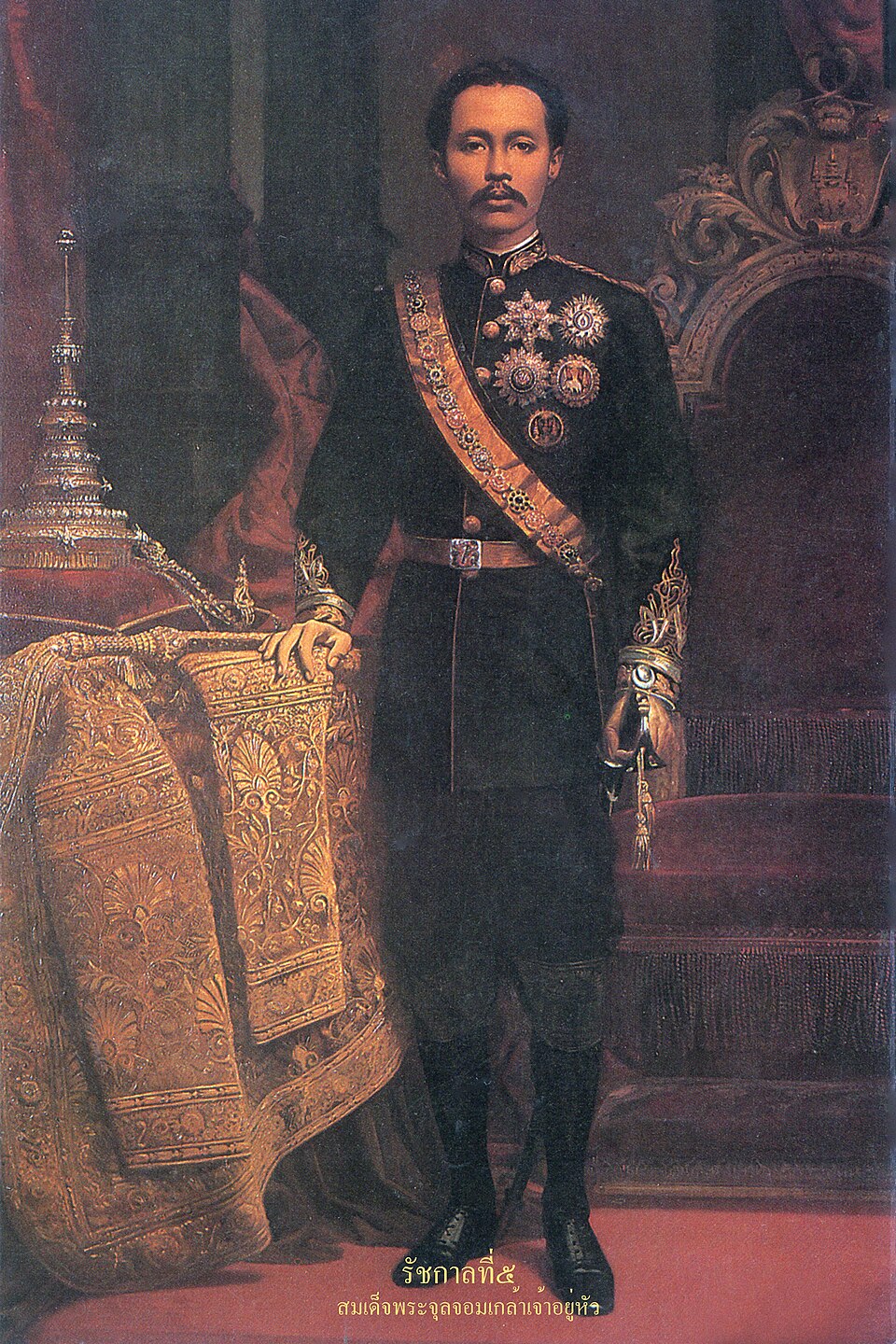
Who they were
Born in 1853, he succeeded his father Mongkut in 1868 and ruled in his own right from 1873 (r. 1868–1910). As the king who led Siam’s modernization, he is counted among the most revered monarchs in Thai history.
What they did
He abolished prostration before the king (1873) and, in a decades-long sequence completed in 1905, gradually abolished slavery and corvée. With ministers including his brother Prince Damrong, he replaced semi-independent lords with centralized monthon administration and created modern ministries (1892), a reformed army, courts, schools, the first railways (1890s), telegraph and survey mapping. He was the first Siamese monarch to travel to Europe (grand tours in 1897 and 1907). Under colonial pressure, French gunboats forced the Paknam passage in the Franco-Siamese crisis of 1893 and Siam ceded the left bank of the Mekong; further cessions followed in 1904 and 1907 (right-bank Lao lands, Battambang and Siem Reap), and the Anglo-Siamese Treaty of 1909 gave four Malay states to Britain. Thai historiography frames these as sacrificing limbs to save the body; the core kingdom kept its independence.
Legacy
October 23, his death anniversary, is Chulalongkorn Day, a national holiday. Chulalongkorn University bears his name, his equestrian statue in Bangkok remains a site of veneration, and he is revered as Phra Piya Maharat — the beloved great king.