Overview
Between 1914 and 1945 the most consequential Australian garment was a uniform. The slouch hat and khaki of the Australian soldier acquired a national meaning that no civilian fashion of the period came close to, and at home two wars and a depression pushed dress toward thrift and plainness.
Key garments and style
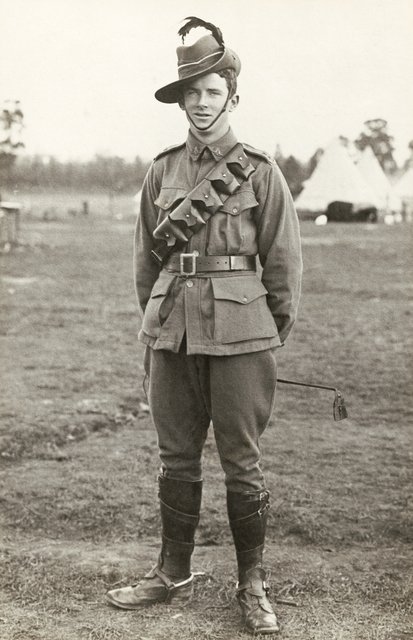
The slouch hat — broad-brimmed felt, one side turned up, with the rising sun badge — was already in use before the First World War but became the emblem of the Anzac after Gallipoli in 1915, and it has stayed the visual shorthand for the Australian soldier ever since. The rest was serviceable wool khaki, cut for a European war and worn in Egypt, Gallipoli and France.
Civilian dress followed international lines, with the dropped waists and shorter skirts of the 1920s reaching Australian cities on much the same timetable as elsewhere, then the longer, leaner 1930s.
The Second World War made austerity official. Clothes rationing by coupon came in from 1942, and austerity regulations restricted the cloth a garment could use — limiting hems, pleats, pockets and trimmings — so wartime clothing is identifiable by what it lacks. Large numbers of women entered uniformed services and war work, and trousers became ordinary daywear for women for the first time.
Transition
Postwar prosperity and a warm climate produced something Australia had not had before: a distinctively local, informal dress built around the outdoors and the beach.