Overview
Gold changed Australian dress twice over. It brought a large, sudden and international population to the diggings, where everyone wore much the same practical outfit whatever they had worn at home; and it made a small number of people rich enough to dress Melbourne like a European capital.
Key garments and style
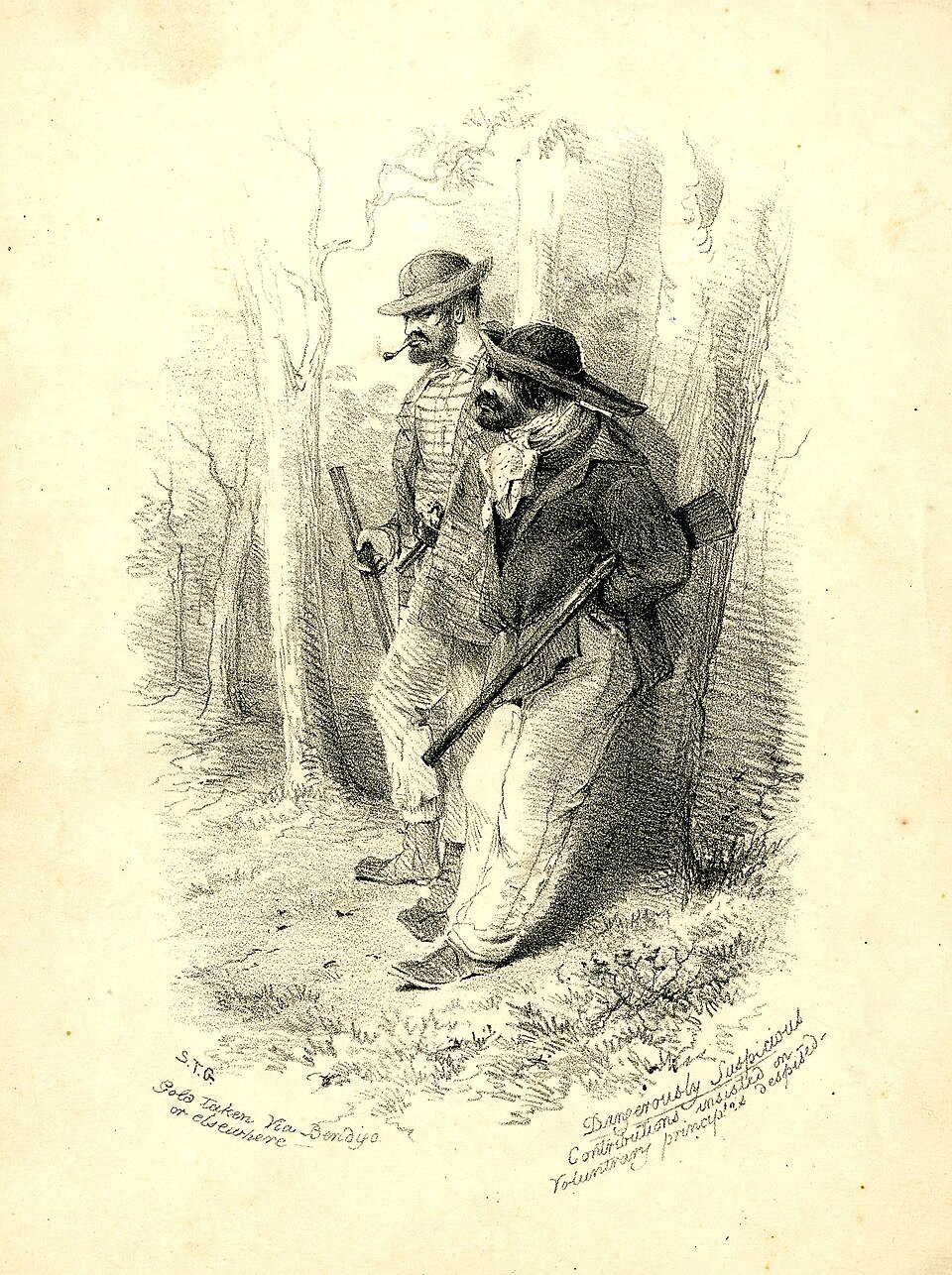
The digger’s outfit is the period’s image: moleskin or corduroy trousers, a heavy flannel or crimean shirt worn as an outer garment rather than an undershirt, stout boots, and a hat against the sun — often the cabbage-tree hat, plaited from palm leaf, which was a genuinely local product and something of a badge.
The point of it was practicality and cheapness in a place where nobody was being seen by anyone who mattered, and photographs of the fields show men from Britain, China, California and Europe dressed nearly identically.
The swagman’s kit belongs to the same economy: a blanket roll, a billy and whatever could be carried between jobs.
In the towns the money went the other way. Melbourne’s wealth paid for imported silks, crinolines and tailoring, and the gap between the diggings and Collins Street was the sharpest dress contrast in the colonies.
Transition
Out of this practical clothing the Federation era began assembling a recognisably Australian style, with the felt hat at its centre.