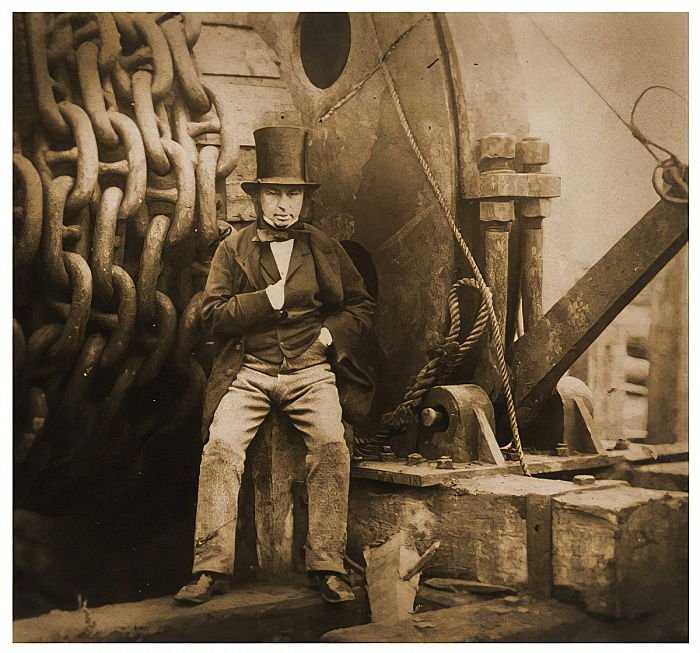
Who they were
Son of the engineer Marc Brunel, with whom he worked on the first tunnel under the Thames, Brunel made his name with the design for the Clifton Suspension Bridge at Bristol and in 1833, aged twenty-seven, became chief engineer of the Great Western Railway.
What they did
He drove the Great Western’s famously level line from London to Bristol, with the Box Tunnel and Maidenhead Bridge, choosing a broad gauge later abandoned in the Gauge War. He then extended the route to sea: the Great Western (1838) proved transatlantic steam service viable, the Great Britain (1843) was the first large iron ship driven by a screw propeller, and the vast Great Eastern (1858), troubled in service, later laid the first lasting transatlantic telegraph cable. He also built the Royal Albert Bridge and the prefabricated Renkioi hospital of the Crimean War.
Legacy
Brunel died in 1859, days after the Great Eastern’s first sea trials; the Clifton bridge was completed in his memory in 1864. His works still carry trains and visitors, and his name stands in Britain for engineering ambition on the grandest scale.