Overview
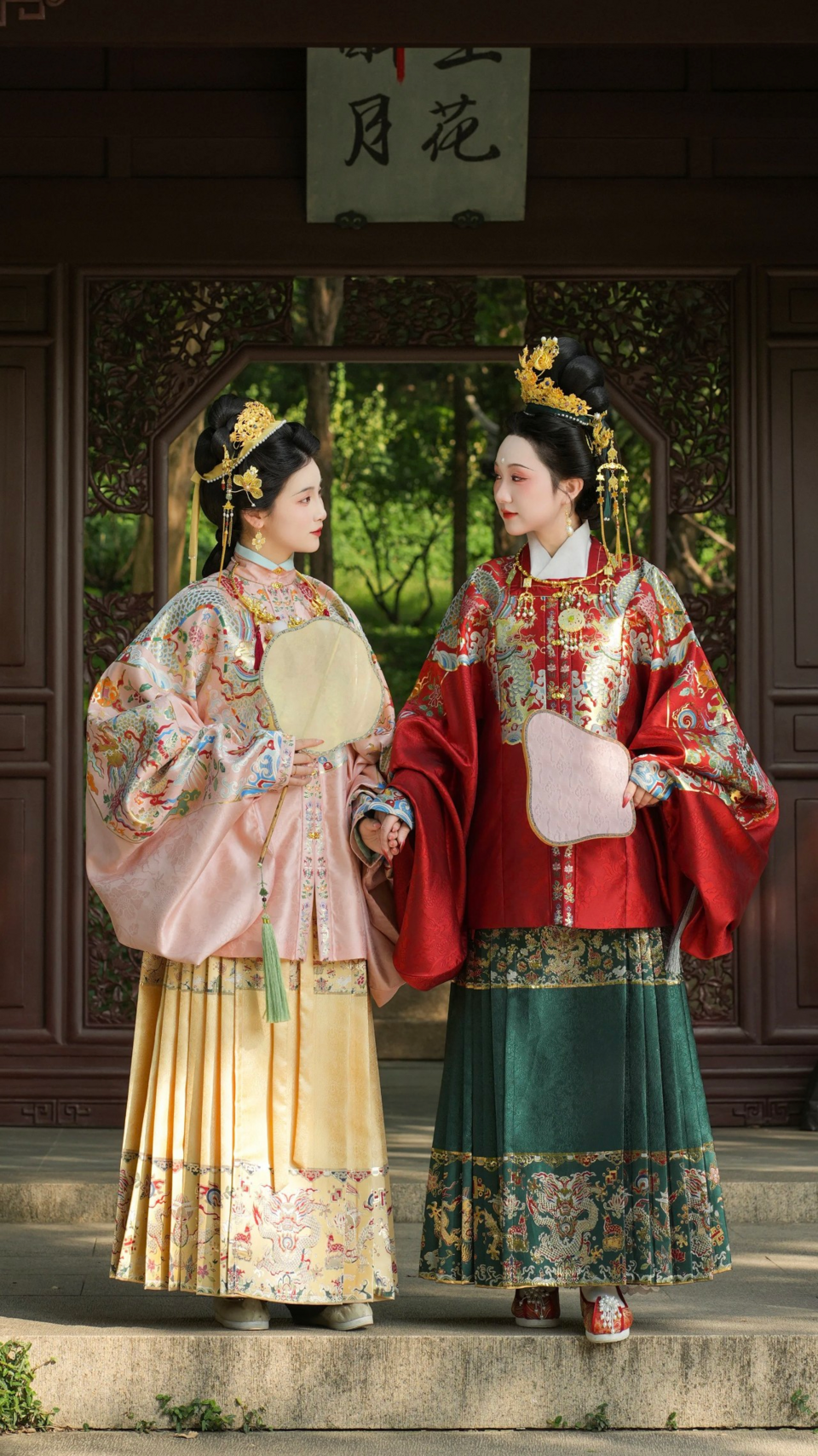
The clothes are reconstructions of specific historical systems rather than a general ‘Chinese’ look: the cross-collared robe of the Han, the ruqun and banbi of the Tang, the round-collared robe and the mamianqun of the Ming, each argued from paintings, tomb figures and surviving garments. That argument is the movement’s substance — enthusiasts distinguish sharply between a reconstruction, a hanyuansu garment merely inspired by one, and a costume-drama invention, and the distinctions are contested in public and at length.
How it is worn
It is worn as clothes, which is the point: to a park, a campus, a coffee shop, a graduation. A full outfit takes several layers in order — inner garment, robe, skirt, sash, outerwear — and much of the practical knowledge circulated in the movement is about how to put those on unaided and move in them. Hair and headwear are treated as part of the system, since a Ming robe with a modern haircut is read by other wearers as an incomplete reconstruction.
History
The usual founding date is 22 November 2003, when Wang Letian, an electric-power worker in Zhengzhou, walked through the city in a self-made robe and was photographed; the movement grew online through forums and then through short video, and by the 2010s had a manufacturing industry behind it. It is entangled with commerce, with tourism photography, and with nationalist politics, and its participants argue about all three — but the durable effect is that Ming and Tang dress are now ordinary sights on Chinese streets.