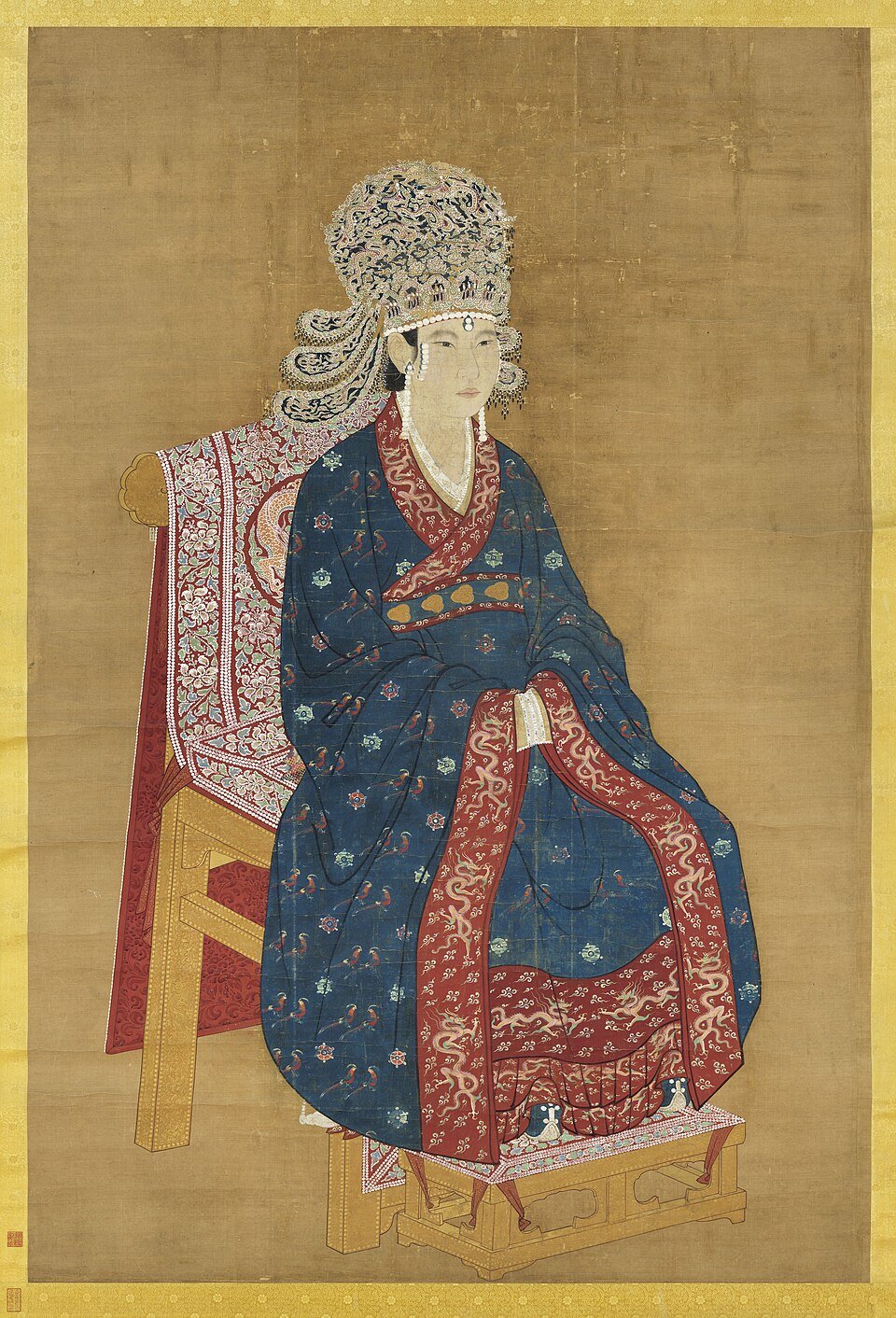
Overview
Song dress is a deliberate retreat from Tang display. Where the Tang had been broad, bright and open to foreign forms, the Song favoured a slender line, muted colour and restraint — an aesthetic that matched the Neo-Confucian temper of the period and produced clothing of considerable subtlety.
Key garments and style
The characteristic women’s garment is the beizi, a long straight jacket open down the front with slits at the sides, worn over a skirt with narrow sleeves and in soft, low-saturation colours. Officials wore round-collar robes with the futou, by now a rigid hat whose two flat wings stretched improbably far to either side — a Song form so distinctive it dates a painting on sight.
Cloth technology was excellent. Song kesi, slit tapestry woven in silk, reached a level of fineness that made it a medium for reproducing painting and calligraphy rather than only for clothing.
The period’s other legacy is not decorative. Footbinding, first described in the Five Dynasties, spread through elite women during the Song and became established, reshaping women’s gait, shoes and mobility for the better part of a millennium — the most consequential change in Chinese dress and the least benign.
Transition
The Mongol Yuan laid steppe dress over this tradition without displacing it, keeping the Han wardrobe in use below a Mongol ruling class.