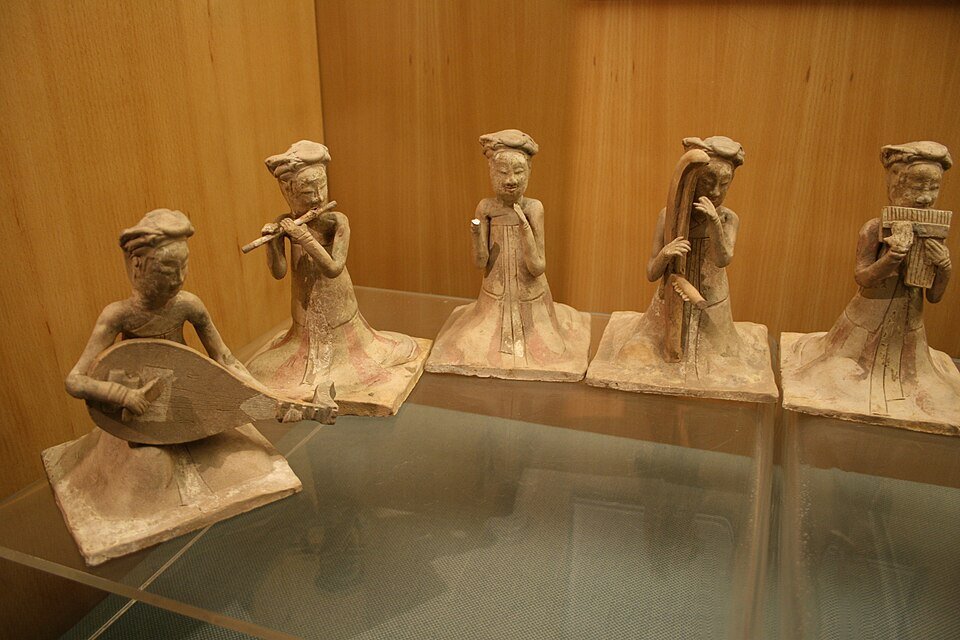
Overview
The dynasty lasted under forty years and reunified a country that had been divided for close to three centuries, and its dress shows the seam. From the northern dynasties came the round-collared robe with a fitted body and a leather belt, a riding garment of steppe origin that the Sui made ordinary wear for officials and kept for court. From the south came the loose, high-waisted, softly draped women’s clothing of the Jin tradition. The court issued dress regulations that graded colour, belt fittings and headwear by office, giving the reunified bureaucracy a single visible order.
How it is worn
The women’s set is a jacket, narrow through the sleeve, worn over a skirt whose waistband has risen to just under the arms and is tied there with a sash, so the whole figure reads as a long vertical. Over it goes the pibo, a long light scarf carried over the shoulders and looped across the arms. Skirts were often made of alternating coloured panels, which is why so many figurines are painted in vertical stripes. Men’s dress was the round-collared robe, closed to the right, worn with soft boots and the futou, a black cloth wrapped over a frame and knotted at the back of the head.
History
The figurines on this page come from the tomb of Zhang Sheng at Anyang, sealed in 595, which is one of the few securely dated Sui assemblages and so does much of the work of fixing the style in time. Almost none of this stopped at the dynasty’s fall in 618. The Tang took the round-collared robe, the futou and the high-waisted skirt straight over and made them famous, and the Sui is now read mostly as the first chapter of that style rather than as a period with a look of its own.