Overview
The Xia is the first of the three dynasties in the Chinese historical tradition, and the tradition is late: the Records of the Grand Historian, written around 100 BC, gives it kings and a chronology more than a thousand years after the fact. Archaeology offers a candidate rather than a confirmation — the Erlitou culture of the middle Yellow River, roughly 1900 to 1500 BC, which has palaces, bronze foundries and a scale of organisation that matches what a dynasty would need. Whether Erlitou is Xia is genuinely unsettled, and any account of Xia dress rests on that unsettled identification before it rests on anything else.
How it is worn
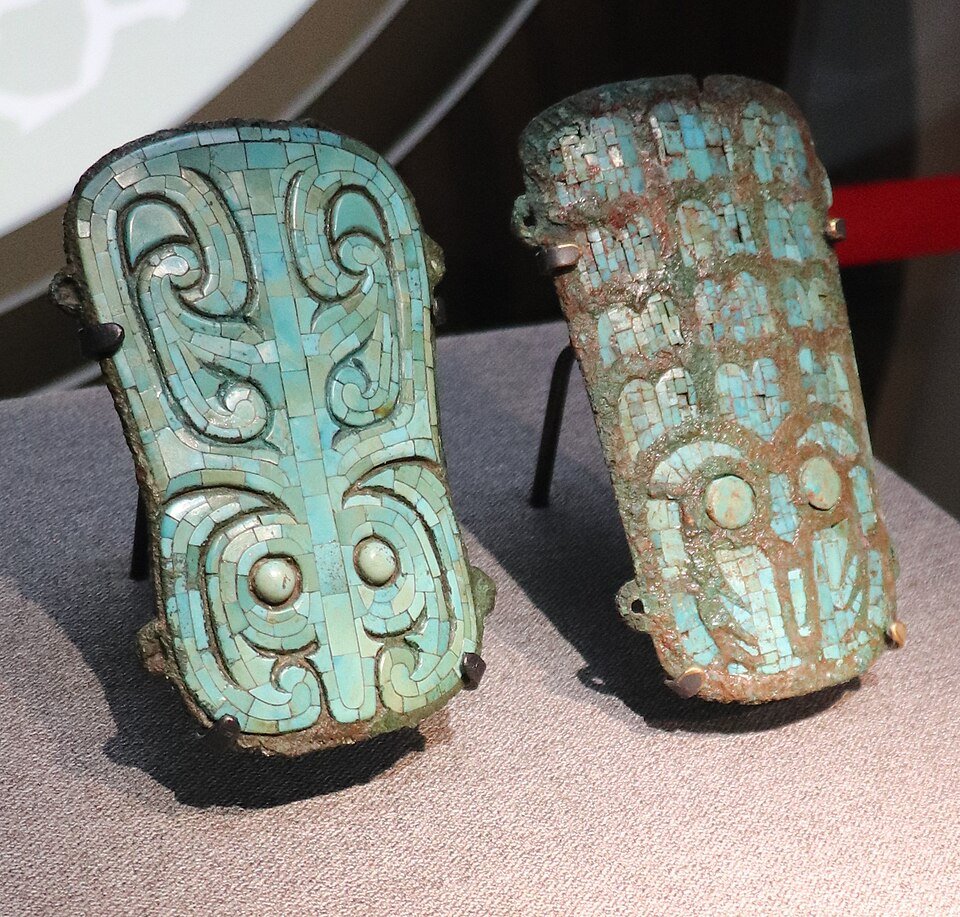
The evidence is worn objects, not clothes. The plaques on this page are bronze, inlaid with hundreds of cut turquoise tesserae in a stylised animal mask, and each has loops cast along its sides — they were sewn or strapped onto something, a garment or a body, and worn on the chest. Their workmanship is the argument: an object of this labour is made to be displayed on a person, which means there was a dress in which display of this kind made sense. Alongside them Erlitou has jade blades and handles, cowrie shells and bone hairpins. Textiles themselves survive only as impressions — the weave of hemp and, at some sites, of silk, pressed into clay or mineralised against bronze.
History
So the honest description is a negative one. There is no basis for saying how a Xia sleeve was cut, whether the robe crossed left or right, or what colour meant. What can be said is that by this period cloth was woven, ornament was worked to a very high standard, and both were being concentrated in a few hands. The picture only opens at the Shang, whose jade and marble figures show an actual person in an actual robe — cross-collared, sashed, closing to the right — and which is where any description of Chinese dress can first be checked against a depiction rather than inferred from a fastening.