Overview
The Palace of Knossos stands near the north coast of Crete and was the largest palace of the Minoan civilization. A first palace raised around 1950 BC was destroyed and rebuilt on a grander plan, and the complex flourished until about 1450 BC, with final destruction following in the decades after.
Description
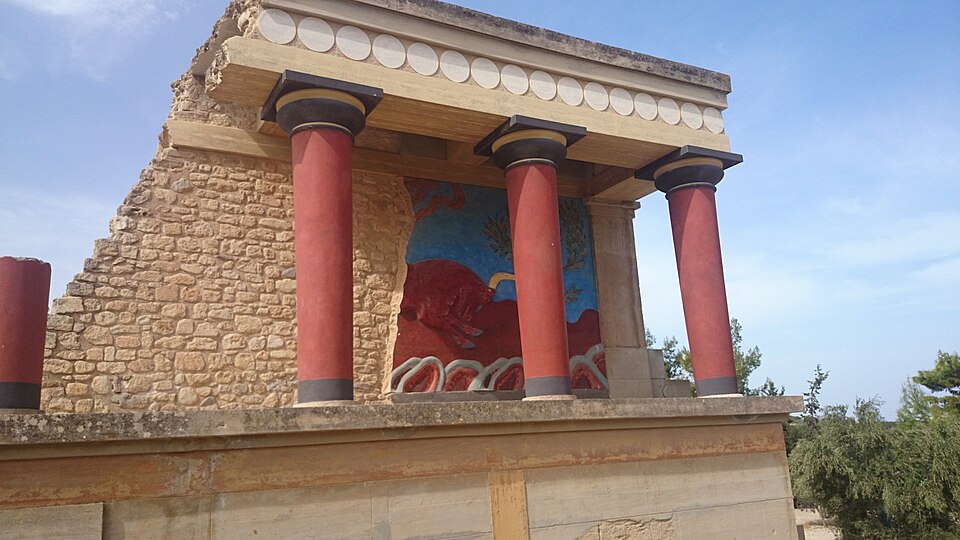
The palace gathers hundreds of rooms around a great central court: storerooms lined with giant pithoi jars, a throne room with gypsum seat and griffin frescoes, light-wells and grand staircases, and the downward-tapering red columns that became the emblem of Minoan architecture. Its walls carried frescoes of extraordinary vitality — bull-leapers, dolphins and processions — whose originals are kept in the Heraklion museum.
History and legacy
Greek legend made Knossos the seat of King Minos and the labyrinth of the Minotaur, a story stated here as legend; the palace’s maze-like plan may lie behind it. Arthur Evans excavated the site from 1900, naming the civilization Minoan, though his concrete reconstructions of parts of the palace remain controversial among archaeologists. Knossos made the Minoan world visible and remains one of the most visited ancient sites in Greece.