Overview
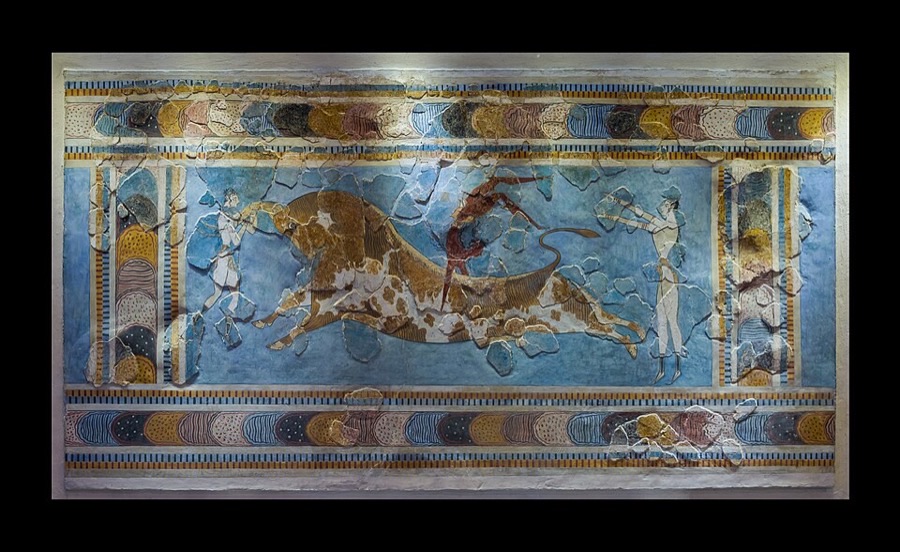
Minoan Crete centered on great palace complexes at Knossos, Phaistos, and Malia, with vivid frescoes of bull-leaping and dolphins, advanced plumbing, and storerooms that served a redistributive economy. Knossos was excavated and partly reconstructed by Evans from 1900 onward, though his concrete reconstructions remain controversial.
Key developments
The Minoans wrote in Cretan hieroglyphs and Linear A, both still undeciphered; the later Linear B used on Crete wrote Greek and belonged to Mycenaean administration. They were a maritime trading power across the Aegean and the eastern Mediterranean, and their towns appear unfortified — though the picture of peaceful Minoans is partly idealization and remains debated.
End and transition
The volcanic eruption of Thera (Santorini), dated somewhere between roughly the 1620s and the 1500s BC and still debated, devastated the region, though its role in the Minoan decline is itself debated. Around c. 1450 BC most of the palaces burned, Mycenaean Greeks took over Knossos, and Minoan civilization merged into the Mycenaean world. Its echoes survive in Greek myth: Minos, the labyrinth, and the Minotaur.