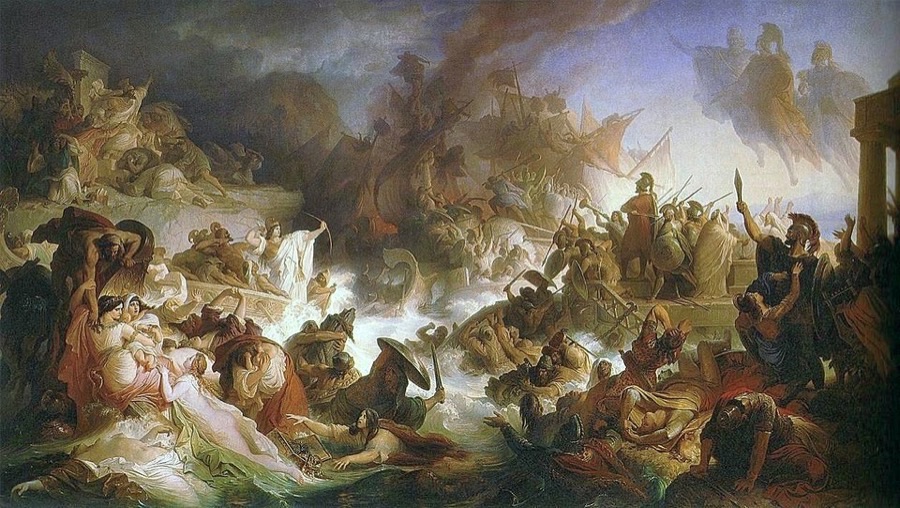
What happened
In late September 480 BC the Greek fleet decisively defeated the Persian fleet in the strait between the island of Salamis and the coast of Attica. According to Herodotus, Themistocles lured the Persians into the narrows with a false message that the Greeks were about to flee. In the confined waters the heavier Greek triremes rammed and broke the crowded Persian lines. The sources add two famous images: Xerxes watching from a throne on the shore, and Artemisia, queen of Halicarnassus, fighting on the Persian side — a celebrated anecdote in Herodotus.
Background
After Thermopylae, Athens was evacuated and burned. The core of the Greek navy was the Athenian fleet, built at Themistocles’ urging with silver from the Laurion mines. Convention puts the Greeks at about 370 triremes against a larger Persian fleet, though all such figures are uncertain.
Consequences
Xerxes withdrew to Asia with much of his army, and the war on land was decided at Plataea the following year, 479 BC. Salamis is often listed among history’s decisive battles and often credited with saving the young Athenian democracy. In the longer view, the standard assessment holds that sea power made Athens’ golden age and its empire possible.