What happened
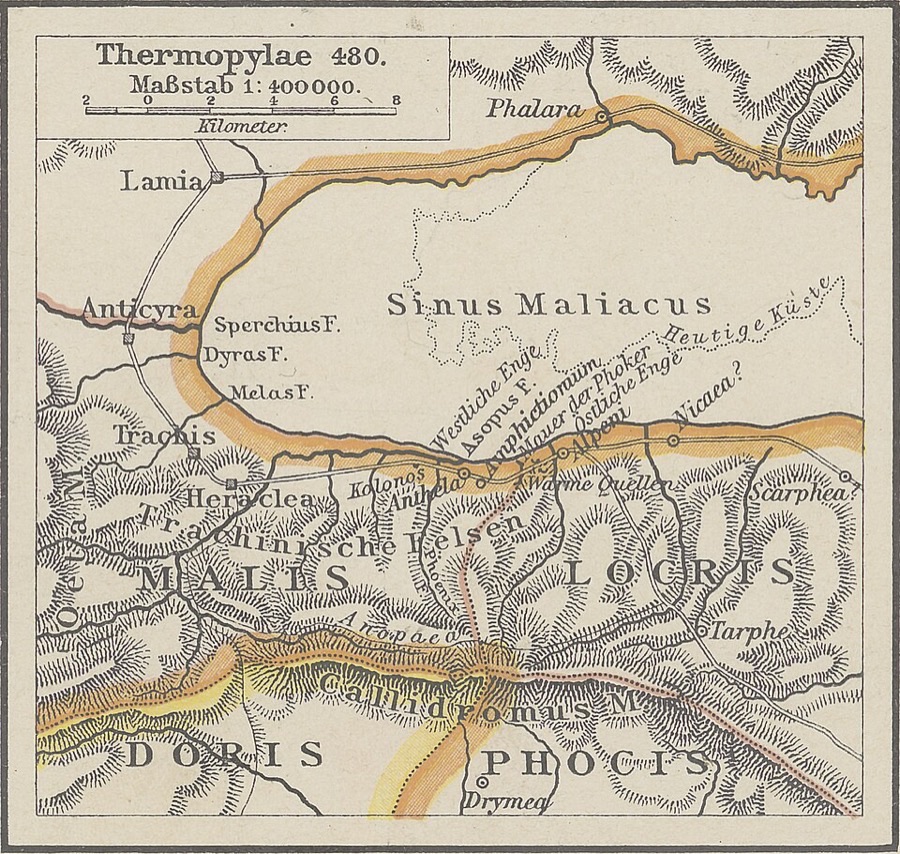
In August or September 480 BC, a small Greek force under the Spartan king Leonidas held the narrow coastal pass of Thermopylae against the vast army of Xerxes I for three days. Two days of frontal assaults broke against the phalanx in the narrows — even the elite Persian unit the Greeks called the Immortals failed. Then a local man, Ephialtes, revealed a mountain path; outflanked, Leonidas dismissed most of the army. He remained, per the tradition, with about 300 Spartans, 700 Thespians, and 400 Thebans — the details are uncertain — and they fought to the death.
Background
The battle came at the gateway of Xerxes I’s invasion of Greece. Herodotus gives the Persian army fantastic numbers running into the millions; modern estimates reach a few hundred thousand at most, and nearly all narrative sources for this war are Greek. At the same time, the Greek fleet was fighting a holding action off nearby Artemisium.
Consequences
In military terms Thermopylae was a Persian victory: the pass fell and Athens was burned. How much the delay was actually worth is debated. The invasion rolled south, setting up the battle of Salamis weeks later. The epitaph attributed to Simonides on the Spartan dead — asking the traveler to tell the Spartans that they lie there, obedient to their laws — became the most famous of Greek epitaphs, and Thermopylae has been invoked ever since as the archetype of the heroic last stand, with no small amount of modern mythologizing.