Overview
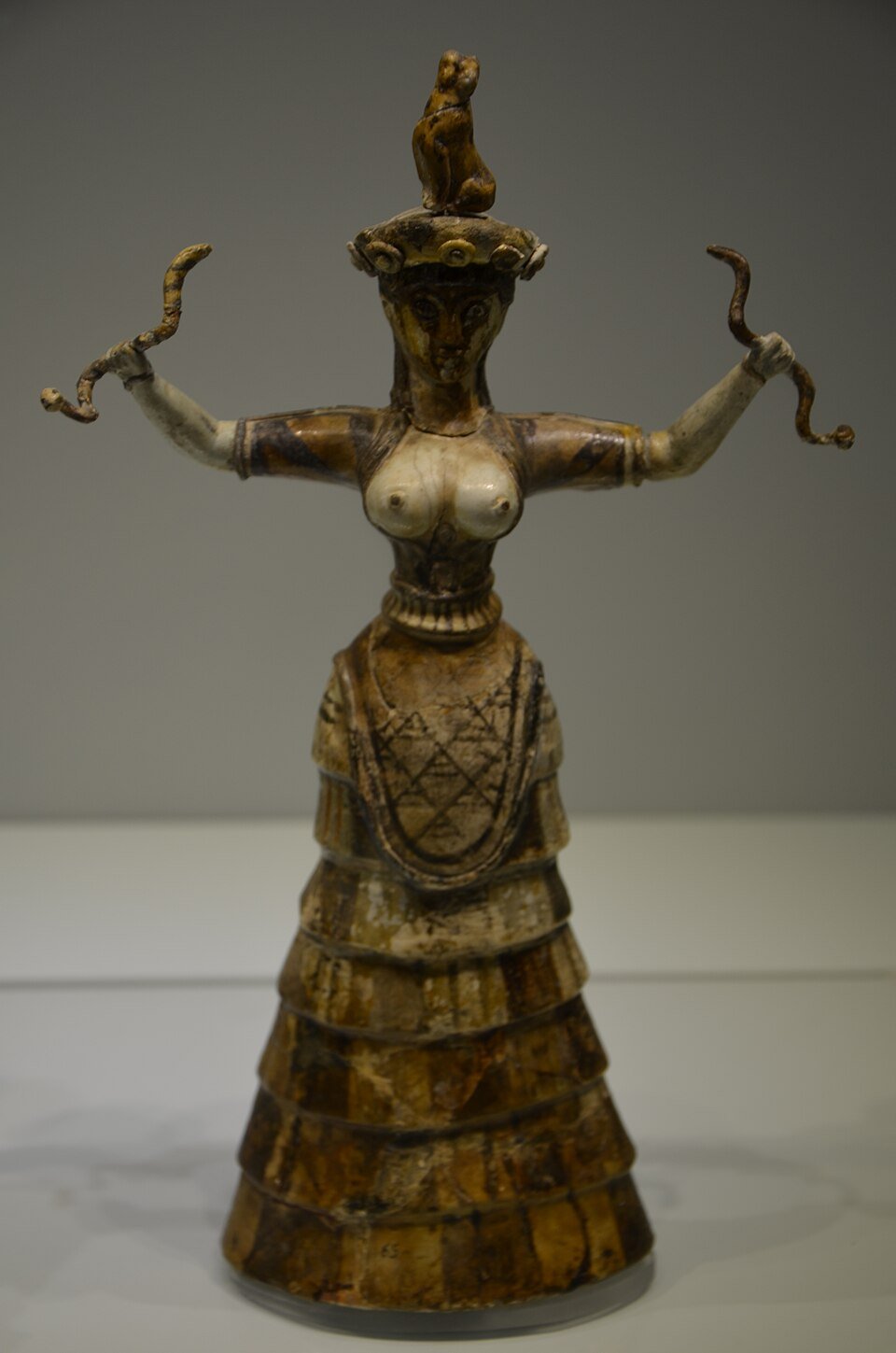
The women’s silhouette is unlike anything else in the Bronze Age Mediterranean. The skirt is built from bands of cloth sewn in overlapping horizontal tiers, sometimes half a dozen of them, flaring from a waist pulled in hard by a rolled or padded belt. Above it the bodice has set-in sleeves and a closely shaped fit, and it stops short at the front, leaving the breasts uncovered. Over the skirt many figures wear a curved apron, front and back. Spindle whorls and loom weights turn up in quantity at the palace sites, so the cloth was being produced at scale, and the frescoes show bands, spirals and net patterns worked into the tiers.
How it is worn
The bodice goes on first and is drawn tight, joined edge to edge below the breast so that the front stays open above it; the sleeves are set in, so it has to be put on like a jacket rather than wrapped, which is real tailoring and sets Minoan dress apart from the pinned and draped clothing of Egypt and later Greece. The belt goes over the join, rolled and pulled hard — in the figurines it is the tightest thing in the outfit. The skirt hangs from it in tiers to the ankle, and where an apron is worn it is tied over the skirt at front and back. Hair falls long over the shoulders in worked locks, and headdresses can be tall. Men wore far less: a short kilt or loincloth held by a belt as tight as the women’s, and usually nothing above the waist. Some scholars read the open bodice as ritual dress worn by priestesses rather than everyday wear, and the argument turns on the fact that almost every surviving image of it is religious.
History
The evidence needs handling with care. Most of the famous images were excavated in fragments and reconstructed in the early twentieth century, and restorers filled the gaps with their own reading of what the dress should look like — the figurine on this page is itself partly restored, including the cat on its headdress. What is certain is the outline, which recurs across independent finds on Crete and at Akrotiri on Thera. After the fifteenth century BC the flounced skirt disappears from the record, and Mycenaean dress takes a different, plainer line.