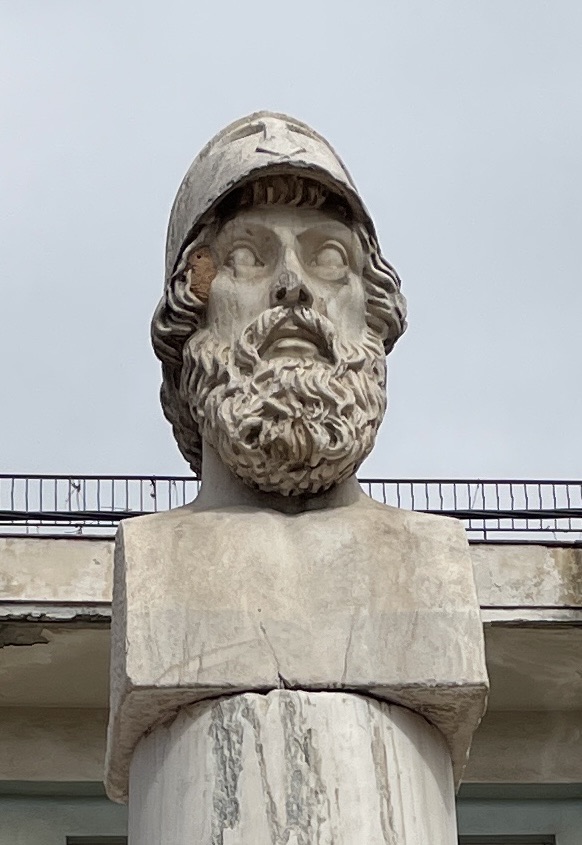
Who they were
Themistocles (c. 524–c. 459 BC) was an Athenian statesman, widely credited as the architect of Athenian sea power and of the Greek victory at Salamis. Thucydides, in a famous assessment, praised his natural genius for improvisation and his foresight.
What they did
In 483/482 BC he persuaded Athens to spend the silver strike at Laurion on a fleet of triremes rather than distribute it — the decision that made Salamis possible. At Salamis in 480 BC, according to Herodotus, his stratagem drew the Persian fleet into the strait. After the war he rebuilt Athens’ walls by diplomatic delay in the face of Spartan objections and fortified Piraeus, founding the city’s maritime future. He then fell from favor: ostracized around 472/471 BC, he was later condemned in absentia amid accusations of collusion with Persia, whose truth is still debated.
Legacy
The end of his career is a great irony: he fled to the Persian empire, was honored by the king, and served as governor of Magnesia in Asia Minor until his death. The tale that he died by drinking bull’s blood is legend. He remains the model of the brilliant, ambiguous statesman — the savior of Greece who died a Persian governor.