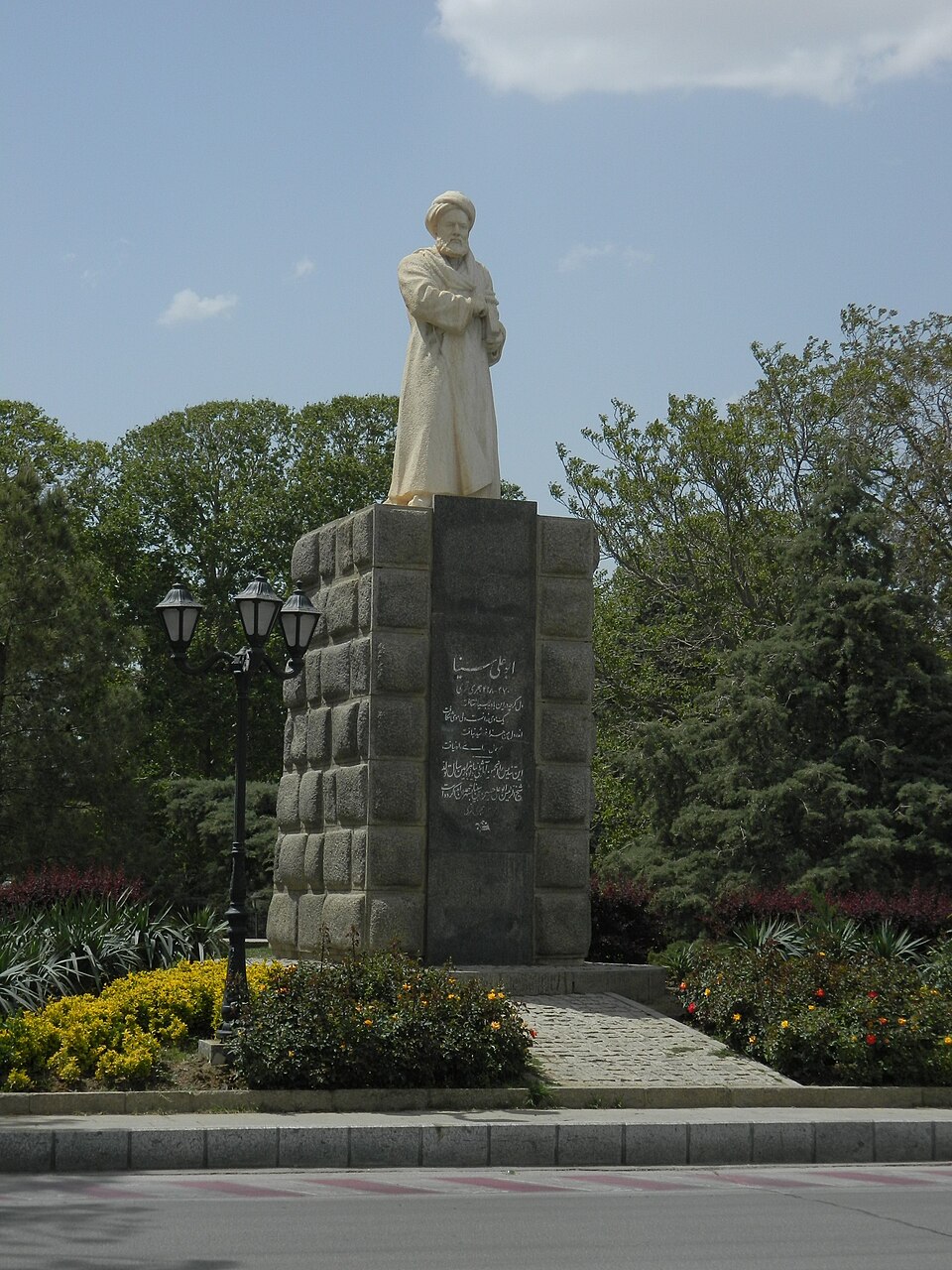
Who they were
Ibn Sina, Latinized as Avicenna (c. 980–1037), was born near Bukhara, in modern Uzbekistan, in the Samanid realm. His career unfolded at Iranian courts — Gorgan, Rey, Hamadan, Isfahan — and he died at Hamadan, where his mausoleum stands. By his own account, in an autobiography that survives, he was a prodigy who mastered the sciences young; he served rulers as physician and sometimes vizier, writing on the move and in prison.
What they did
His Canon of Medicine (al-Qanun fi al-Tibb) systematized Greco-Arabic medicine, and in Latin translation it served as a standard European medical textbook for centuries, into the early modern period. His philosophical encyclopedia, the Book of Healing (al-Shifa), set out a metaphysics — the essence–existence distinction, the Necessary Existent, the floating man thought experiment — that by standard assessment shaped both later Islamic philosophy and, through Latin translations, medieval European scholasticism. He wrote mainly in Arabic, and also in Persian.
Legacy
Avicenna is a central figure of the Islamic golden age and of Iranian intellectual heritage. His name became proverbial for the physician-philosopher across Eurasia, and he is commemorated across the Persian-speaking world and beyond.