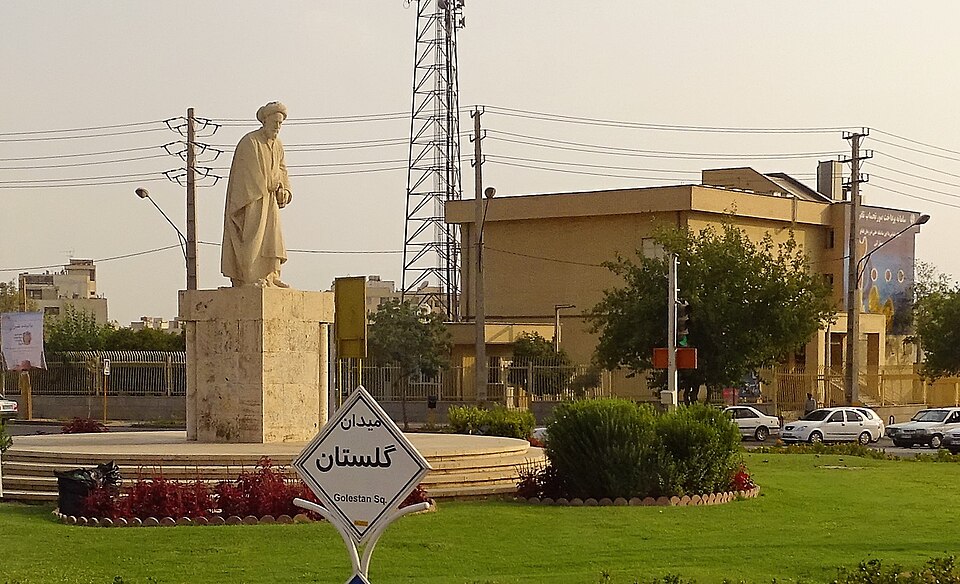
Who they were
He was born at Shiraz around 1210 and studied at the Nizamiyya in Baghdad, the leading college of the age. He left as a young man in the upheavals of the Khwarazmian and Mongol era and travelled for decades across the Islamic world, though scholars caution that the extent of the journeys he describes is partly literary self-fashioning. He came back to a Shiraz that its Salghurid rulers had kept out of the Mongols’ path by submitting early — which is why his two masterworks, finished in 1257 and 1258, were written in one of the few Persian cities that were not in ruins.
What they did
He returned to Shiraz under the local Salghurid rulers and produced his two masterworks in successive years: the Bustan (The Orchard, in verse, 1257) and the Gulistan (The Rose Garden, in mixed prose and verse, 1258) — moral tales told with wit and worldly wisdom in a famously limpid style. His ghazals stand with the great Persian lyric tradition, and by standard assessment his prose style shaped Persian literary education for centuries.
Legacy
His celebrated verse on humankind as one body — its members created of one essence, so that when one member suffers the others cannot rest — is often linked to the United Nations: a Persian carpet bearing the verse, gifted by Iran, has hung in a meeting room at UN headquarters in New York since 2005 — the popular claim of an inscription at the entrance is a myth — and the US president Barack Obama quoted the verse in his 2009 Nowruz message. His tomb in Shiraz, the Saadieh, rebuilt in the mid-20th century, is a major monument, and in Iran his day is commemorated annually.