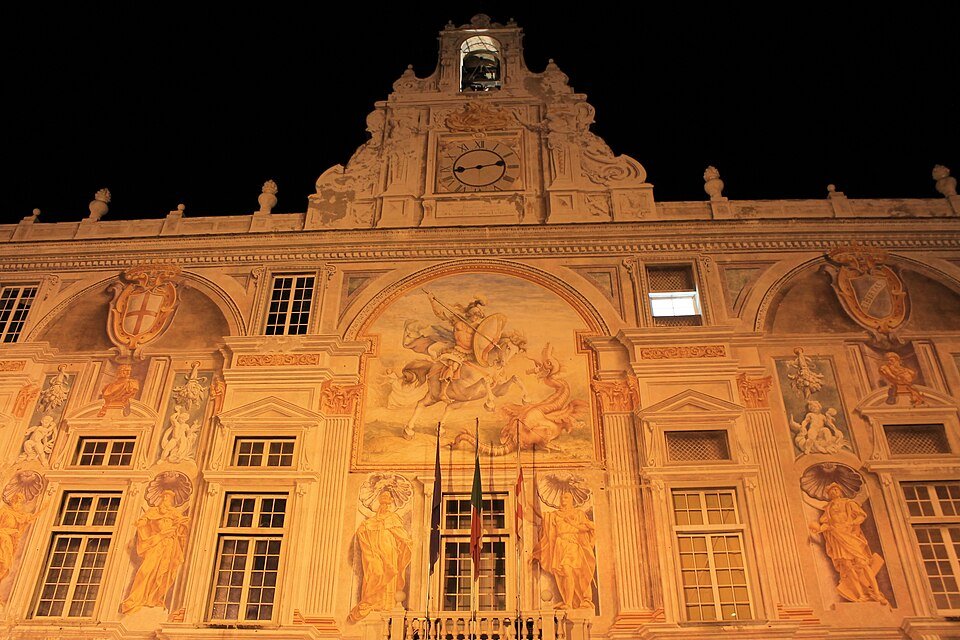
What it was
The Republic of Genoa grew out of the commune the city’s citizens formed around 1099, at the start of the Crusades. From its narrow strip of Ligurian coast Genoa lived by the sea — ships, trade, and finance — and became, with Venice and Pisa, one of Italy’s great maritime republics.
Role
Genoa crushed Pisa at the naval battle of Meloria in 1284 and fought Venice for over a century, until the War of Chioggia (1378–1381) ended its bid for supremacy. Its merchants built a network of colonies and trading posts across the Mediterranean and Black Sea — Caffa in Crimea, Chios in the Aegean, Pera beside Constantinople. The Bank of Saint George, founded in 1407 and among Europe’s oldest banks, managed the state’s debt and even governed some of its colonies. After Andrea Doria’s constitutional reform of 1528 the republic aligned with Habsburg Spain, and Genoese bankers financed the Spanish crown so thoroughly that historians speak of a century of the Genoese. Christopher Columbus was born in Genoa in 1451, though the voyages that made him famous sailed under the Spanish crown.
Fate
Unable to put down the Corsican rebellion, Genoa sold the island to France in 1768. Napoleon’s invasion ended the old republic in 1797, replacing it with a Ligurian Republic, and the Congress of Vienna assigned Genoa to the Kingdom of Sardinia in 1815. The bankers’ palaces still line the old city, and Giuseppe Mazzini, the ideological soul of the Risorgimento, was born there in 1805.