Overview
The Greek cities of southern Italy and Sicily dressed as Greeks, and did so at some distance from Greece — which is why their dress matters beyond themselves. These cities were the channel through which Greek clothing conventions reached the Etruscans and the Romans, so the toga’s ancestor and the Roman pallium both pass through here.
Key garments and style
The wardrobe is the standard Greek one: the chiton, a tunic fastened along the shoulders and often along the upper arm so it falls in pleats, worn under the himation, a rectangular mantle wound about the body; and for women the heavier pinned peplos in the earlier period. Fibulae and pins do the fastening, and the arrangement of the mantle carries the elegance.
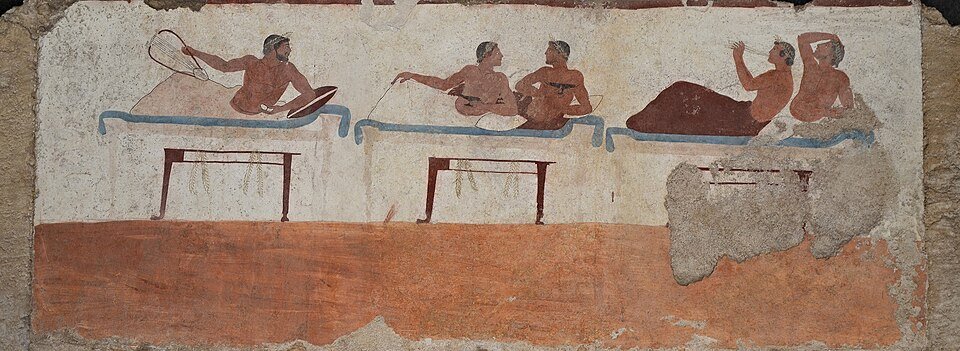
The evidence is unusually rich because these cities produced South Italian red-figure pottery in quantity, and its painters — Apulian and Lucanian above all — drew drapery with care. Terracotta figurines from Tarentum and Locri add the same information in three dimensions. Tarentum was famous in antiquity for its wool and for a purple dye industry, so this was a cloth-producing region and not only a cloth-wearing one.
Local variation appears in ornament rather than cut, with the gold jewellery of Tarentum among the finest in the Greek world.
Transition
As Rome absorbed the south, this dress passed into the Roman repertoire, where the Greek mantle became the pallium and remained the marker of the Greek-educated for centuries.