Overview
Medieval Italy is where Europe learned to make silk. The garments themselves were the common European ones — layered tunics under a mantle — but the cities that made and traded the cloth for the rest of the continent were Italian, and that industrial fact shapes everything that follows, including the Renaissance.
Key garments and style
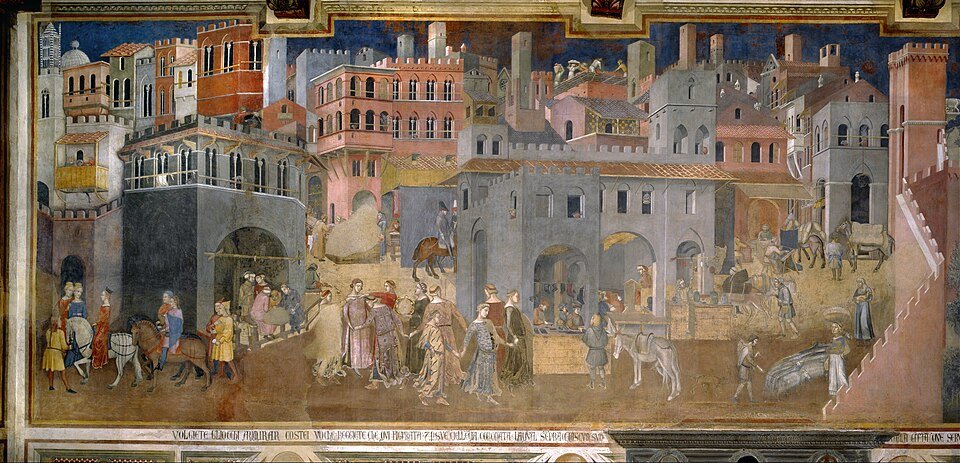
Men and women both wore the cotta, a fitted tunic, over a linen undergarment, with a mantle above and hose or stockings below; the cut is close to what was worn from Flanders to Sicily.
The distinctiveness is in the material. Lucca was the first great Italian silk city, and its weavers, dispersed by political upheaval in the early fourteenth century, seeded the industry at Venice, Florence and Bologna. Sicily under the Normans ran a royal workshop in Palermo staffed by Muslim craftsmen, whose most famous product is the coronation mantle made for Roger II in the 1130s — an Arabic-inscribed silk that became the coronation robe of the Holy Roman Emperors.
The communes legislated against display incessantly. Sumptuary statutes limited sleeve widths, trains, buttons and furs, and were reissued so often that their main documented effect is evidence of how thoroughly they were ignored.
Transition
From the late fourteenth century the courts and the silk cities together produced the Renaissance wardrobe, and for a century Italy set European fashion rather than only supplying it.