Overview
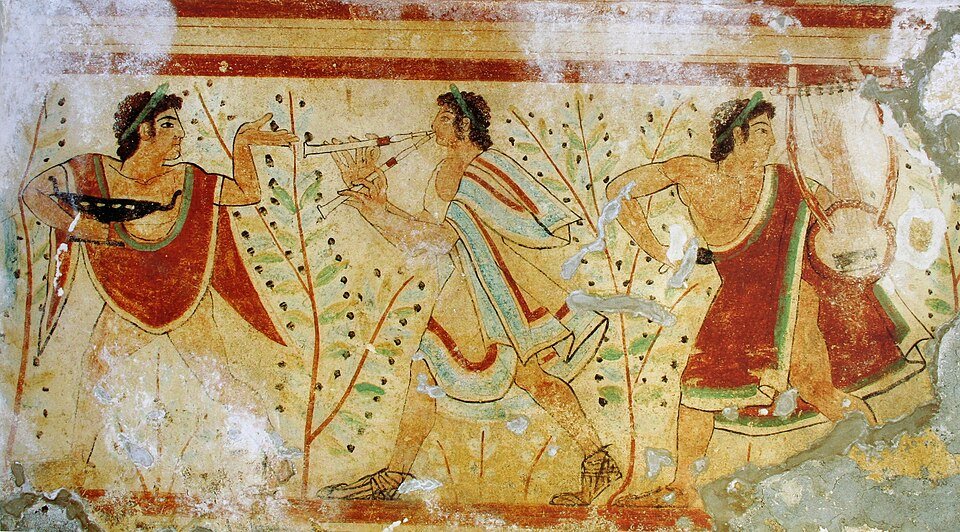
Etruscan dress matters twice over: for itself, and because Rome took so much of it. The toga descends from the Etruscan mantle, the magistrate’s purple border and curved shoes came the same way, and Roman writers said so. It is also unusually visible, because the Etruscans painted the insides of their tombs in colour.
Key garments and style
The characteristic garment is the tebenna, a mantle cut on a curve rather than as a rectangle — the shape that makes a toga drape as it does — worn over a tunic by both sexes. Shoes are a signature: the calcei repandi, with long upturned pointed toes, appear so consistently that they identify an Etruscan figure at a glance. Women wore the tutulus, a conical cap, and both sexes wore a great deal of gold.
Etruscan goldsmiths were the finest in the Mediterranean, and granulation — fusing minute gold spheres onto a surface without visible solder — was carried to a level later craftsmen struggled to reproduce.
The tomb paintings of Tarquinia show something else that struck contemporaries: women reclining at banquets beside men, dressed and adorned in public. Greek writers found this scandalous and said so, which tells us the dress was doing social work a Greek would not have expected.
Transition
As Rome absorbed Etruria, the tebenna became the toga, the purple border became the toga praetexta, and Etruscan dress survived inside Roman public costume rather than beside it.