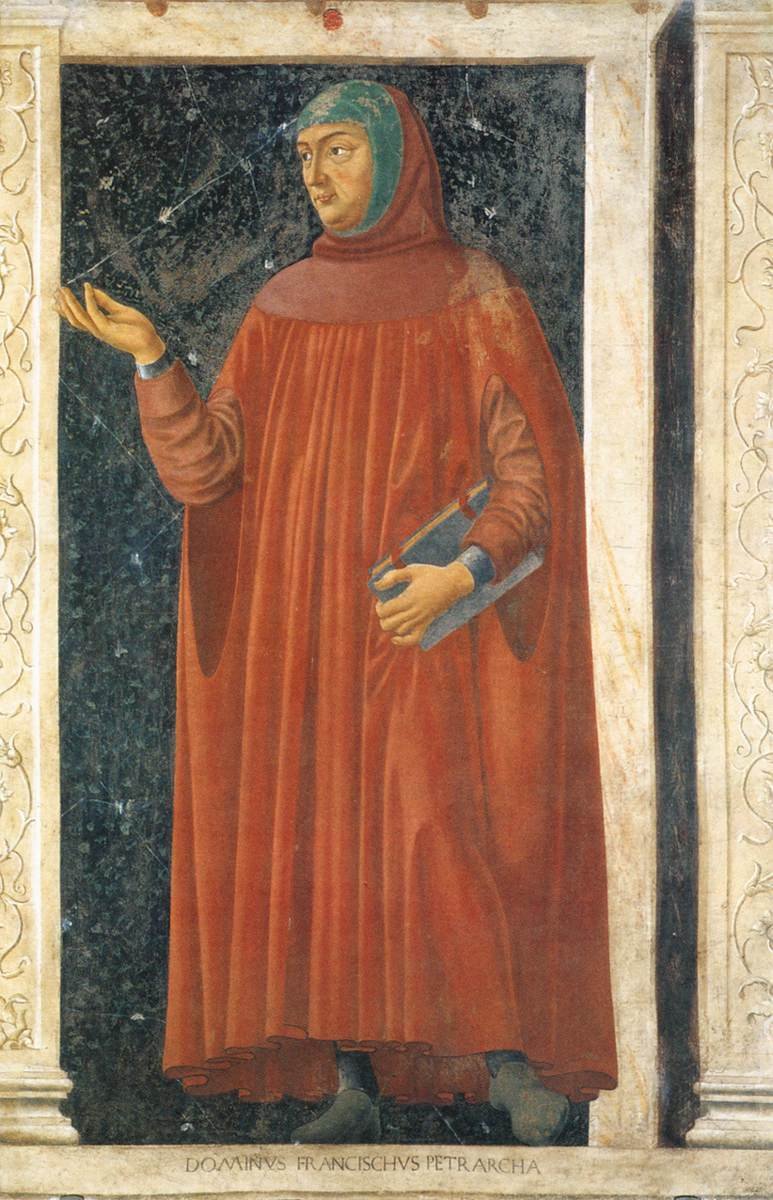
Who they were
Petrarch — Francesco Petrarca — was born in Arezzo in 1304 and spent much of his life around Avignon and in the courts of northern Italy. Celebrated across Europe in his own lifetime, he was crowned poet laureate on the Capitol in Rome in 1341.
What they did
His Canzoniere, a cycle of Italian poems addressed to a woman he called Laura, perfected the sonnet form that European poets imitated for the next three centuries. Just as important was his scholarship: he hunted down forgotten classical manuscripts, most famously rediscovering Cicero’s letters to Atticus in Verona in 1345, and made the recovery of antiquity an intellectual program. His account of climbing Mont Ventoux in 1336 is often cited as an early expression of a modern sensibility toward landscape, though scholars debate that reading.
Legacy
Renaissance humanism — the study of the classical past as a guide to living and writing — grew directly from his program, and the notion of the preceding centuries as a dark age is closely associated with him. With Dante and Boccaccio he is counted among the three crowns of Italian literature, and the Petrarchan sonnet still bears his name.