Overview
Bangkok’s dynasty began by reconstructing Ayutthaya and ended the century reconstructing itself. Siamese court dress under Rama IV and Rama V changed deliberately and visibly, as part of a policy of presenting Siam to European powers as a modern state — dress as diplomacy, at a time when looking uncivilised was a pretext for colonisation.
Key garments and style
Early Rattanakosin dress continued Ayutthaya: the chong kraben for both sexes, the sabai for women, gold-brocaded cloth by rank.
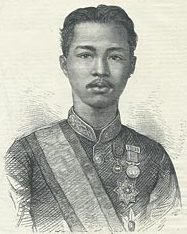
From the mid-nineteenth century a hybrid appears that is peculiar to Siam. Court women wore the chong kraben with a lace or European-cut blouse, stockings and shoes; men wore it with a high-collared white jacket, and the combination was formal court dress rather than a compromise. Photographs of Chulalongkorn’s court show it precisely.
Rama VI pushed further, encouraging women to move from the chong kraben to a wrapped skirt worn with Western blouses, and to grow their hair long rather than keep the cropped style then usual.
Underneath, the ordinary population went on wrapping cloth much as before.
Transition
After 1932 the state promoted Western dress outright and later assembled the chut thai as an official national costume, which is the ancestor of what is worn ceremonially today.