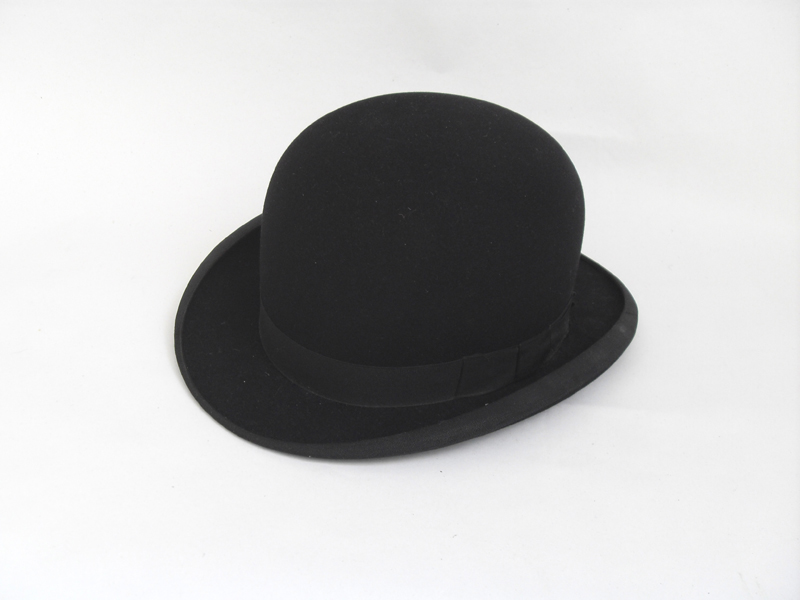
Overview
The body is rabbit or beaver felt, blocked into a low dome and stiffened with shellac until it is genuinely hard; the brim is narrow and curled up at the sides. It sits between the top hat and the soft cap in formality, and the details — crown height, brim curl, ribbon width — were how a wearer signalled his trade. Black is the City hat, grey the racing one, and brown the country one.
How it is worn
It is worn level and low on the brow, not tilted, and it should be gripped by the brim front and back rather than by the crown, which crushes a soft hat but not this one. Doffing it was a full removal, unlike the cap’s brim-touch. In the City of London the bowler with a rolled umbrella was a uniform so exact that it was legible at a distance, and photographs from the 1950s show whole streets of it.
History
Edward Coke commissioned it from Lock & Co. in 1849 for gamekeepers who kept losing top hats to low branches; the hatters Thomas and William Bowler made it, and their name stuck. It was a working hat before it was a clerk’s, and the American West bought more of them than it did Stetsons. Aymara and Quechua women in Bolivia adopted it in the 1920s from a surplus shipment, and they are now its largest population of daily wearers.